
Abstract
Indian cities produce more solid waste than their local waste management systems can effectively pick up, and this deficit is most pronounced in slums where the streets are too narrow for effective collection and civic coherence is weak, which makes open dumping acceptable. This paper is an empirical case study of community based solid waste management (SWM) scheme, Ekjut Kanpuriya Abhiyan, which was implemented by the project team in Kanpur Nagar urban slums, Uttar Pradesh. The study investigates how a behavioural and institutional change which is generated by a local leadership intervention, rather than capital infrastructure, is durable. A qualitative, embedded design of single case was used, based on documentation from the pilot period (2024) in three river-side settlements and the second period (February–July 2025), which involved an extension of the model to four additional settlements. Evidence comprised project reports, participatory rural appraisal records, key informant interviews and focus group discussions, a register of 45 community ambassadors, and field photographs, analysed thematically. The intervention involved ambassador-led household engagement, leadership building, source segregation and composting, rooftop kitchen gardens, art-based communication and the development of Swachhata Samitis in collaboration with ward councillors and the Kanpur Nagar Nigam. The results recorded so far are composting in 100 households, over 100 kitchen gardens, twenty-five campaigns for cleanliness, and more than 2,000 residents have participated, and monthly meetings with elected representatives have been institutionalised. Two case stories are drawn from allied field interventions that demonstrate the same logic of peers in a different thematic area. This case indicates that urban sanitation is more about co-production which is achieved through negotiated relationships with municipal actors and is less about technology.
1. Introduction
One of the most characteristic problems of urban waste management in India is that of municipal solid waste management. In cities, waste generation exceeds collection and treatment capacity, and this gap is persistent, with consistently low rates of source segregation and a lack of capacity to treat waste before it is collected (Sharholy et al., 2008; Vij, 2012; Kumar et al., 2017). According to Solid Waste Management Rules 2016, segregation at source was now made a statutory duty of the waste generator (Ministry of Environment, Forest and Climate Change, 2016), making it difficult for municipal machinery to handle as there would be thousands of kitchens where compliance is to be achieved.
A public service can only be delivered through the unmonitored routine activities of citizens, thus making it a process of co-production (Ostrom, 1996; Mansuri & Rao, 2013). The residents of informal settlements are generally regarded as consumers of sanitation services, rather than as users who embody the system, whose day-to-day practices make it either succeed or fail. The concept of tokenistic consultation and citizen power (Arnstein, 1969) is still useful for diagnosis and the social learning theory accounts for why local models are more convincing than outside advice, as demonstrated by Bandura (1977) and Rogers (2003).
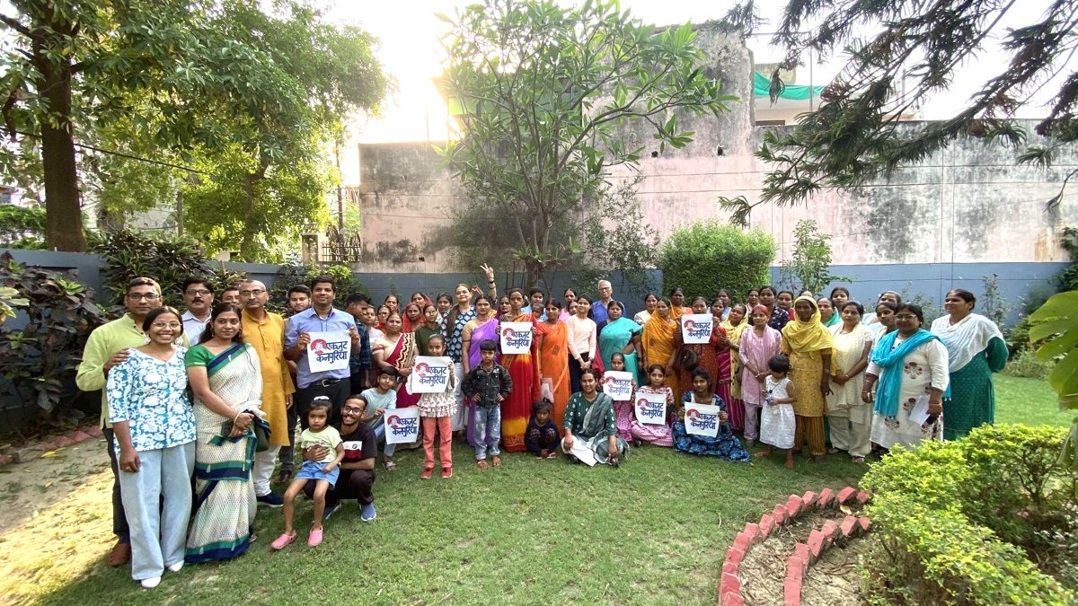
Failure is not about looks. Uncollected waste restricts drainage, leads to standing water and provides vector habitat, and was recorded in participatory assessments as being most problematic in the study settlements for dengue, malaria, skin infections and respiratory complaints, particularly by children and older residents. Kanpur is where the problem occurs in a concentrated form, with a population of about three million, and it produces 1,500 to 1,700 metric tonnes of waste per day, on the bank of the Ganga River. In this context, the Ekjut Kanpuriya Abhiyan has focused on three settlements around the riverside since 2024, with 45 community ambassadors, and, in its second phase (2024-25), four additional settlements, on the path from awareness to local institution-building and engagement with the municipalities (Figure 1).
Figure 1. The Ekjut Kanpuriya campaign team with community participants, Kanpur Nagar. Source: Project documentation (2025).
1.1 Objectives of the Case Study
The study pursues six objectives:
- To document the community participation architecture of the campaign, particularly the selection, roles and functioning of community ambassadors and Swachhata Samitis.
- To profile the communities and stakeholders engaged, and to map the institutional actors with whom residents interacted.
- To analyse the intervention strategies adopted, including segregation, composting, kitchen gardens, art-based communication and community development activities.
- To assess documented environmental, social and governance outcomes across the two implementation phases.
- To identify the challenges encountered and the mitigation measures adopted in response.
- To derive transferable lessons for replication of community-led sanitation models in comparable urban settlements.
2. Background and Geographical Context
Kanpur is one of the biggest industrial hubs of Uttar Pradesh and also a major urban centre on Ganga. The riverside belt has high density informal settlements, and most of them have informal jobs. The three pilot settlements, Rani ka Bagicha, Mannipurwa and Toshakhana, are located in the Ranighat area and have similar physical characteristics in terms of close living quarters, narrow lanes, open drains and close proximity to the river, making every unmanaged dump a source of pollution to the river. The second phase included the addition of four settlements that met the following explicit criteria: Official notification status, proximity to the pilot area, willingness to participate, and feasibility of field coordination (Table 1).
Table 1. Settlements covered and associated local governance units
| Settlement / Basti | Phase of entry | Ward No. | Swachhata Samiti formed |
| Ranighat cluster (Rani ka Bagicha, Mannipurwa, Toshakhana) | Pilot; continued in Phase 2 | 13 | Azaad Swachhata Samiti |
| Noor Mohammad ka Hata | Phase 2 | 6 | Bagvani Swachhata Samiti |
| Rajapurwa | Phase 2 | 64 | Subharambh Swachhata Samiti |
| Chunabhatiya | Phase 2 | 5 | Jagriti Swachhata Samiti |
| Varmacell | Phase 2 | 6 | Samriddhi Swachhata Samiti |
Pre-intervention conditions were recorded using participatory rural appraisal technique (social mapping, seasonal calendars, focus group discussions and problem ranking – Chambers, 1994). The results are similar in all settlements. There was some basic understanding of segregation but it was not commonly used, as households did not have separate containers and were not sure about waste categories, but mixed waste was thrown in a common basket or openly. The most common complaints were for irregular municipal collection and in its absence residents left waste in empty plots or drains or burnt them; plastic pile-ups blocked drains during the monsoon. Civic entitlement was also missing in other forms as residents reported drinking water shortages.
Table 2. Settlement-wise findings from participatory rural appraisal, Phase 2
| Settlement | Key issues identified | Actions suggested by residents | Stated needs |
| Noor Mohammad ka Hata | Open dumping; no collection | Composting; awareness drives | Waste bins; health education |
| Rajapurwa | Waste near water; flooding | Segregation; recycler linkages | Collection points; protective equipment |
| Varmacell | Mosquito breeding; no segregation | School campaigns; IEC tools | Community bins |
| Chunabhatiya | Irregular pick-up; dumping | Clean-ups; women-led monitoring | Compost training; regular pickup |
3. Community and Stakeholder Profile
The communities involved are the notified and non-notified informal settlements of households that rely on daily wage labour, small trade, domestic service and self-employment for their livelihood. The campaign was achieved by a network of community ambassadors, comprising 45 residents selected for the pilot, and 15 from each settlement. Their profile is analytically significant (Table 3). Of the two-thirds who were women, leadership was found to be at the household level where segregation and composting take place, and where women were also excluded from planning identified by the assessments (Agarwal, 2001). The large majority were young (more than half were aged 25 years or younger), ranging from 17 to 63 years, so that the cadre was made up of younger and older residents. Students, homemakers, self-employed, private sector, teacher and retired serviceman.
Table 3. Profile of community ambassadors in the pilot settlements (n = 45)
| Settlement | Ambassadors | Women | Men | Age range (years) | Aged 25 or under |
| Toshakhana | 15 | 8 | 7 | 17-45 | 9 |
| Mannipurwa | 15 | 14 | 1 | 22-45 | 8 |
| Rani ka Bagicha | 15 | 8 | 7 | 18-63 | 8 |
| Total | 45 | 30 | 15 | 17-63 | 25 |
In addition to residents, the intervention involved multiple layers of institutional actors, such as sanitation workers at the settlement level, and city-level sanitation management and administration, as well as a waste collection company and partners for assessment and capacity development. This stakeholder architecture is summarised in Table 4, and was the interface through which community claims were then channeled.
Table 4. Community and institutional stakeholder profile
| Stakeholder group | Composition | Role in the intervention |
| Community ambassadors | 45 residents across three pilot settlements; 7 carried into Phase 2 | Household mobilisation, demonstration, peer mentoring |
| Swachhata Samitis | 10-15 residents per settlement, including women, youth and elders | Local problem-solving, monthly review, municipal liaison |
| Ward councillors | Elected representatives of Wards 5, 6, 13 and 64 | Monthly meetings, participation in drives, escalation of issues |
| Municipal sanitation staff | Sanitary inspectors, zonal sanitation officers, safai nayaks and karmacharis | Field coordination, collection and drive support |
| City administration | Municipal Commissioner, Mayor, Chief Health Officer | Policy support, recognition, resource allocation |
| Service agency and partners | Waste collection contractor; external assessment and training partners | Route alignment, needs assessment, councillor orientation |
4. Methodology of the Case Study
This study uses a qualitative, embedded single case design (Stake, 1995; Yin, 2018). Case: Ekjut Kanpuriya Abhiyan as implemented in Kanpur Nagar until July 2025; Embedded Units: seven settlements in which Ekjut Kanpuriya Abhiyan was implemented. The design is appropriate for a phenomenon that is inseparable from its context, and in which the interest of analysis is mechanisms of change rather than effect size against a counterfactual. The data sources included documentary and field data. They include project and event reports, minutes of participatory rural appraisal recorded settlement by settlement, a register of 45 ambassadors, including socio-demographic data (age, gender, occupation, locality) and their assigned role, activity and training records, and field photographs that documented the activity and physical transformation at specific sites as evidence. The primary qualitative data collected included key informant interviews (KIIs) with key municipal officials and focus group discussions (FGD) with community stakeholder groups facilitated by an independent research agency to ensure objectivity (Table 5; Figures 2 and 3).
Table 5. Key informant interviews and focus group discussions conducted for the needs assessment
| Stakeholder group | Method used | Purpose |
| Community leaders | FGDs | Understand leadership perspectives and local governance roles |
| Women’s groups | FGDs | Explore household-level practices and gender-specific issues |
| Youth representatives | FGDs | Gather views on awareness, participation and solutions |
| Municipal staff | KIIs | Identify operational challenges and gaps in service delivery |
| Health and sanitation workers | FGDs and KIIs | Assess health impacts and frontline worker experiences |
| Affected residents | FGDs | Capture lived experiences of waste-related issues |
Figure 2. Key informant interviews with municipal officials and accompanying field visits. Source: Project documentation (2025).
Figure 3. Focus group discussions with community participants across the settlements. Source: Project documentation (2025).
Data collection was preceded by ethical clearance and prior informed consent. Interviews, discussions and documentation of the case-stories were conducted with the participants, who were informed about the purpose of this study and gave their consent to the use of their answers and photographs for research and dissemination purposes, with institutional permission secured from the implementing organisation. Participation was voluntary and identifying information was anonymized for limited consent. The design has three limitations: much of the evidence comes from the programme phase and is retrospective; the improvements in the pilot phase were quantified, not instrumented; and there was no separate household survey. The paper thus makes analytical and not statistical generalisations.
5. Community Engagement and Participation Model
The Ekjut Kanpuriya Campaign was based on the community ambassador model, which involved trained citizens who were responsible for spreading awareness about sustainable waste management practices among their neighbours. Ambassadors were engaged in various activities such as waste segregation awareness, composting, kitchen gardening, upcycling, plantation, wall painting, and community outreach. They actively participated in their assignments, fostering trust and promoting peer-to-peer learning. As the settlement expanded, mature ambassadors kept teaching the model in new settlements.
Figure 4. Household segregation bins for dry, organic and reject waste used in community demonstrations. Source: Project documentation (2025).
Figure 5. Household-level composting demonstration conducted with women residents. Source: Project documentation (2025).
Much of the communication burden was in cultural forms. The Swachhata Geet on segregation, composting and plantation and the Nukkad Natak on the health impacts of street waste were created and performed by the ambassadors, which facilitated to put technical messages of segregation and composting in memorable words and place the ambassadors as competent actors in the public eye. There has been consistent documentation of community response, from scepticism about how often cleaned spaces would remain clean, to a participatory excitement as visible changes build up, and then a protective pride that translated into maintenance. Reactions were not always positive as some residents had reservations about the artwork and this difference is proof of a genuine participation rather than staged participation.
6. Intervention Strategies and Community Development Activities
The intervention adopted simple and practical approaches for waste management that would be easily applicable by the communities. More than one hundred households were instructed in two and three bin waste separation systems for dry, organic and reject waste, respectively, leading to segregation practices. Demonstrations and videos were used to educate about composting without the need for expensive equipment. Follow-up visits were made regularly which helped to solve problems pertaining to pests, odour and water logging. Rooftop and courtyard kitchen gardens were also being introduced, with a linkage of composting with domestic benefits. Waste services were enhanced and community participation in sustainable waste management practices was strengthened through the use of cleanliness drives, municipal collaboration and feedback mechanisms.
Table 6. Community development activities under the campaign
| Activity | Content and method | Support provided |
| Kitchen garden training | Container gardening in buckets, tubs and repurposed packaging; crop selection for limited space; soil boosters; organic pest management using neem and garlic | Seasonal seeds, pest management kits, composting and plant care guides |
| Household composting | Live demonstration, video material and follow-up visits; wet waste mixed with soil | Refresher training and guidance on bin placement |
| Cleanliness drives | 25 weekend drives with municipal and agency participation; resident mobilisation by field coordinators | Escalation of systemic issues; route and schedule alignment |
| Art-based communication | Wall paintings and murals at habitual dumping sites, executed with residents | IEC materials, paints and creative facilitation |
Figure 6. Kitchen garden development training for community participants. Source: Project documentation (2025).
Figure 7. Cleanliness drives conducted with Urban Local Body participation. Source: Project documentation (2025).
Art-based communication served as a tool to change behaviour instead of a decorative element, and transformed disposal-related places into collective effort-related places (Figure 9). In total, the awareness campaigns reached over 2,000 residents in the seven settlements, with the assistance of the IEC materials on the categories of waste, use of dustbins and composting (Figure 10). However, the most significant institutional change was the creation of Swachhata Samitis (or committees) of 10-15 residents in each settlement and their capacity building in outreach, behaviour change communication and formal application writing, including the use of right-to-information requests (RTI) to the municipal officials (Figure 11). Sami and ward councillors met each month (Figure 12), councillors went on drives, and painting activity began.
Figure 8. Ambassadors performing the Prerna Geet on solid waste management at the culmination event with decision-makers. Source: Project documentation (2024).
Figure 9. Community wall painting at former dumping sites. Source: Project documentation (2025).
Figure 10. Awareness drive with IEC materials on waste segregation and reuse. Source: Project documentation (2025).
Figure 11. Capacity-building training of Swachhata Samiti members, June 2025. Source: Project documentation (2025).
Figure 12. Monthly meetings between Swachhata Samiti members and ward councillors. Source: Project documentation (2025).
7. Case Stories
7.1 Case Story 1: Shani: Transforming Purana Kanpur Through Creative Sustainability
Shani, a student of Tosha Khana, Purana Kanpur, is a key force in the Abhiyan – Ekjut Kanpuriya solid waste management project at the age of 19. Shani is a natural introvert but has managed to make a difference in his community’s environment by combining education and art.
Key Initiatives
Waste Education: Shani conducts rallies to educate the residents of the city on waste segregation, dustbin usage and domestic composting. Environmental Art: He is a proficient painter and utilises murals to convey environmental messages and takes used plastic bottles to craft a new ‘Planters’ design that greens up public spaces. Community Cleanup: His work has had a direct impact on the local community’s health and hygiene, and has made places that were once neglected into beautiful and vibrant areas.
Figure 13. Shani using creative environmental art and wall painting as a medium to spread awareness about cleanliness, waste management, and sustainable community practices.
Overcoming Challenges
Shani faced significant hurdles, including social anxiety and limited funding. He overcame his shyness by focusing on visual demonstrations rather than public speaking and tackled resource shortages by using recycled materials for his projects. While he initially met with community resistance, Shani built trust by engaging local influencers and showing tangible, beautiful results.
The Impact
Today, Shani’s dedication has led to higher community participation and a cleaner, more aesthetic living environment. His story proves that creative solutions and persistence can turn skepticism into widespread respect and environmental action.
Figure 14. Shani transforming discarded materials into creative environmental artworks, demonstrating the role of recycling and upcycling in sustainable community development.
7.2 Case Story 2: The Artist Of Mannipurwa: How Meera Gautam Upcycles A Cleaner Future
Meera Gautam, a 40-year-old graduate from Mannipurwa, Purana Kanpur, serves as a powerful example of how grassroots leadership can originate from the most familiar spaces. As a dedicated housewife and environmental ambassador for local solid waste management initiatives, Meera has turned her passion for nature into a community-wide movement for sustainable living. initiatives, transforming discarded plastic bottles, old newspapers, and fabric scraps into functional home décor. By hosting hands-on workshops, she demystified the recycling process, proving to skeptical neighbors that waste is a valuable resource rather than a burden. Her artistic demonstrations served as a “visual proof of concept” that effectively overcame initial community resistance. Creative Advocacy and “Waste-to-Wealth” Central to Meera’s impact is her ability to blend art with advocacy. She pioneered “Waste-to-Wealth” Meera’s success was built on resilience. She navigated limited access to tools and materials by improvising with available resources and launching community donation drives for waste supplies. To manage the demanding balance between her activism and her responsibilities to her family, she integrated environmental work into her daily routine. By involving her husband and sons in her projects, she turned her household into a hub for sustainability, demonstrating that environmentalism can be a shared family value. Her crowning achievement was the physical and social transformation of a derelict, non-functional pumping station.
Figure 15. Meera Gautam’s Waste-to-Wealth Initiative and Community Space Transformation in Mannipurwa, Purana Kanpur
8. Impact and Outcomes
Environmental outcomes are most visible at the level of specific sites. Locations that functioned as habitual dumping grounds were cleaned, beautified and subsequently maintained, and the project’s own assessment of the pilot phase records substantial reductions in litter and dumping alongside improved disposal behaviour where bins were regularly placed (Table 7). These are project estimates and indicate direction rather than magnitude. More robust as evidence is the continued maintenance of reclaimed sites and the replication of cleanliness drives in neighbouring lanes without project prompting.
Table 7. Reported transformation of waste hotspots in the pilot settlements (project estimates)
| Settlement | Site or activity | Before | After | Reported change |
| Rani ka Bagicha | Gaushala Gate entrance | Dirty, neglected | Clean, maintained | 80% decrease in litter |
| Rani ka Bagicha | Old stairs | Waste accumulation | Clean, enhanced | 75% decrease in waste |
| Toshakhana | Community dustbins | Few, irregular | Regularly placed | 60% increase in proper disposal |
| Toshakhana | Wall paintings | Dirty, neglected | Vibrant, maintained | 70% improvement in appearance |
| Mannipurwa | Disused pumping station | Dumping ground | Cleaned, converted to usable space | 75% reduction in dumping |
| Mannipurwa | Plantation and composting | Limited activity | Established gardens | 50% increase in composting |
Social and governance outcomes are more securely documented (Table 8). Composting was adopted by around one hundred households, with participation strongest among women, and more than one hundred households established kitchen gardens using their own compost. Around twenty-five young residents moved into leadership roles. Residents who had previously expressed dissatisfaction with elected representatives were, by the close of the second phase, meeting them monthly, submitting written applications on specific sanitation failures, and identifying which authority to approach for which issue. The relationship between settlement and municipality shifted from complaint to structured negotiation.
Table 8. Documented outcomes of the second phase, February to July 2025
| Outcome domain | Documented result |
| Household practice | Composting initiated in over 100 households; more than 100 households developed kitchen gardens using household compost |
| Community institutions | Swachhata Samitis constituted in each settlement, holding monthly review meetings |
| Leadership | Around 25 young residents developed into community leadership roles; women led composting and awareness activity |
| Participation | Over 2,000 residents took part in awareness drives, rallies and events; 25 cleanliness drives conducted |
| Governance linkage | Monthly meetings with ward councillors institutionalised; at least three written applications submitted to the municipal corporation by each of five settlements over four months |
| Service delivery | Waste collection agency adjusted routes and schedules and oriented staff to support segregation |
9. Information, Education and Communication (IEC) Activities
9.1 Media Engagement and Coverage
As part of its ongoing efforts to enhance public awareness and media engagement in the area of solid waste management, Shramik Bharti organized a press conference under the Ekjut Kanpuriya Abhiyan. The objective was to highlight and recognize the role of community-based leadership in driving behavioral change.
Key Components
Media Participation: The event was attended by representatives from various print and electronic media outlets, providing a platform for broad outreach and coverage.
- Community Engagement: Sanitation ambassadors from seven bastis—Rani Ka Bagicha, Toshakhana, Mannipurwa, Chunabhattiya, Rajapurwa, Varmacell, and Noor Muhammad Ka Hata—shared their experiences, challenges, and successes in mobilizing local communities around cleanliness and waste management.
- Facilitated Dialogue: The Shramik Bharti project team conducted interactive sessions with the media, allowing for in-depth discussions on the campaign’s progress and future direction.
- Acknowledgement of Media Partners: Media representatives were recognized and appreciated for their continued support and contribution to publicizing the initiative.
This engagement reinforced the importance of community-driven sanitation efforts and contributed to broader visibility for the Ekjut Kanpuriya Abhiyan. The platform served to elevate local voices, strengthen collaborative ties with the media, and support the campaign’s strategic goals for inclusive and sustainable sanitation reforms.
10. Challenges and Mitigation
Implementation encountered behavioural, technical, institutional and political constraints. Behaviour change proved to be a maintenance problem rather than a conversion problem: cleaned sites attracted fresh dumping and required repeated drives and monitoring. Composting failures, variable political cooperation, internal disagreement within committees and irregular municipal services each required an adaptive response, summarised in Table 9. A further limitation concerns evidence rather than implementation: without baseline and endline household measurement, the durability of change over a six-month window cannot be established with confidence.
Table 9. Challenges encountered and mitigation measures adopted
| Challenge | Mitigation measure |
| Slow behaviour change among residents | Regular home visits, engagement of community ambassadors, and reinforcement through wall paintings and visual materials |
| Inconsistent municipal services | Sustained coordination with the collection agency and continuous advocacy with municipal officials |
| Household hesitation around composting | Step-by-step demonstrations and garden-related incentives to encourage adoption |
| Limited cooperation from one ward councillor | Minimal but formal engagement maintained, ensuring basic duties were fulfilled |
| Time constraints of a supportive councillor | Participation ensured through his representatives in monthly meetings and activities |
| Composting failures from pests, odour and waterlogging | Follow-up visits, refresher training and guidance on correct placement |
| Reappearance of waste at cleaned sites | Repeated cleanliness drives, community sensitisation and monitoring mechanisms |
| Difficulty scheduling meetings with officials | Persistent follow-up by field coordinators to ensure representation |
| Internal conflicts within basti-level committees | Mid-course replacement of some members; committees subsequently stabilised |
| Irregularity among sanitation staff | Regular follow-up, coordination and accountability mechanisms |
11. Lessons Learned and Recommendations
The ambassador model was effective because the members of the community were chosen locally, with clearly defined roles, and were openly acknowledged for their contributions. Future programmes should continue to have these attributes and should be expanded with the assistance of experienced ambassadors in the role of peer mentors. Local partnerships are crucial, especially linking trained residents to municipal systems via applications, responsibility mapping and meeting regularly. Creative activities and environmental education within the school can enhance the participation of the young. Household-level monitoring of segregation, composting and disposal practices is necessary to ensure effective monitoring. The model’s transferability features participatory assessment, local leadership, visible benefits of solutions and long-term cooperation with municipal authorities.
12. Conclusion
The Ekjut Kanpuriya Abhiyan showcases how positive change in urban waste management can be achieved without any significant capital expenditure, as long as the intervention happens within the settlement and does not reach the settlement. Two-thirds of people were women, and they were ordinary residents who were taking up a service problem that the formal systems had been unable to address, using practices that were not too burdensome to implement by people with low incomes in their neighbourhood. The results from the seven settlements suggest that participation was at the level of decision-making, not consultation; and that the most lasting impact that participation can possibly have is a change in the relationship between residents and the municipal system, such that a community that learns how to make a claim can do so even after a project has been completed.
Acknowledgement and Author Field Engagement
The author, Faiza Akram, was directly associated with the field documentation and community engagement activities reported in this paper, including participatory mapping, data compilation and creative workshops with community youth (Figure 15). The support of community ambassadors, Swachhata Samiti members, municipal officials and the project field team is gratefully acknowledged.
Figure 15. The author, Faiza Akram, during field documentation, participatory mapping and creative workshops with community participants under the Ekjut Kanpuriya Abhiyan.
REFERENCES
- Agarwal, B. (2001). Participatory exclusions, community forestry, and gender: An analysis for South Asia and a conceptual framework. World Development, 29(10), 1623-1648. https://doi.org/10.1016/S0305-750X(01)00066-3
- Arnstein, S. R. (1969). A ladder of citizen participation. Journal of the American Institute of Planners, 35(4), 216-224. https://doi.org/10.1080/01944366908977225
- Bandura, A. (1977). Social learning theory. Prentice Hall.
- Bharucha, Z. P., Mitjans, S. B., & Pretty, J. (2020). Towards redesign at scale through zero budget natural farming in Andhra Pradesh, India. International Journal of Agricultural Sustainability, 18(1), 1-20. https://doi.org/10.1080/14735903.2019.1694465
- Braun, V., & Clarke, V. (2006). Using thematic analysis in psychology. Qualitative Research in Psychology, 3(2), 77-101. https://doi.org/10.1191/1478088706qp063oa
- Chambers, R. (1994). The origins and practice of participatory rural appraisal. World Development, 22(7), 953-969. https://doi.org/10.1016/0305-750X(94)90141-4
- Cornwall, A. (2008). Unpacking ‘participation’: Models, meanings and practices. Community Development Journal, 43(3), 269-283. https://doi.org/10.1093/cdj/bsn010
- Guerrero, L. A., Maas, G., & Hogland, W. (2013). Solid waste management challenges for cities in developing countries. Waste Management, 33(1), 220-232. https://doi.org/10.1016/j.wasman.2012.09.008
- Hoornweg, D., & Bhada-Tata, P. (2012). What a waste: A global review of solid waste management. World Bank.
- Joshi, R., & Ahmed, S. (2016). Status and challenges of municipal solid waste management in India: A review. Cogent Environmental Science, 2(1), 1139434. https://doi.org/10.1080/23311843.2016.1139434
- Kaza, S., Yao, L., Bhada-Tata, P., & Van Woerden, F. (2018). What a waste 2.0: A global snapshot of solid waste management to 2050. World Bank.
- Khadse, A., Rosset, P. M., Morales, H., & Ferguson, B. G. (2018). Taking agroecology to scale: The zero budget natural farming peasant movement in Karnataka, India. The Journal of Peasant Studies, 45(1), 192-219. https://doi.org/10.1080/03066150.2016.1276450
- Kumar, S., Smith, S. R., Fowler, G., Velis, C., Kumar, S. J., Arya, S., Rena, Kumar, R., & Cheeseman, C. (2017). Challenges and opportunities associated with waste management in India. Royal Society Open Science, 4(3), 160764. https://doi.org/10.1098/rsos.160764
- Mansuri, G., & Rao, V. (2013). Localizing development: Does participation work? World Bank.
- Michie, S., van Stralen, M. M., & West, R. (2011). The behaviour change wheel: A new method for characterising and designing behaviour change interventions. Implementation Science, 6, 42. https://doi.org/10.1186/1748-5908-6-42
- Ministry of Environment, Forest and Climate Change. (2016). Solid Waste Management Rules, 2016. Government of India.
- Ministry of Housing and Urban Affairs. (2021). Swachh Bharat Mission-Urban 2.0: Operational guidelines. Government of India.
- Narayan, D. (1995). The contribution of people’s participation: Evidence from 121 rural water supply projects. World Bank.
- Ostrom, E. (1996). Crossing the great divide: Coproduction, synergy, and development. World Development, 24(6), 1073-1087. https://doi.org/10.1016/0305-750X(96)00023-X
- Patton, M. Q. (2015). Qualitative research and evaluation methods (4th ed.). SAGE.
- Pretty, J. N. (1995). Participatory learning for sustainable agriculture. World Development, 23(8), 1247-1263. https://doi.org/10.1016/0305-750X(95)00046-F
- Rogers, E. M. (2003). Diffusion of innovations (5th ed.). Free Press.
- Scheinberg, A., Wilson, D. C., & Rodic, L. (2010). Solid waste management in the world’s cities. UN-Habitat and Earthscan.
- Sharholy, M., Ahmad, K., Mahmood, G., & Trivedi, R. C. (2008). Municipal solid waste management in Indian cities – A review. Waste Management, 28(2), 459-467. https://doi.org/10.1016/j.wasman.2007.02.008
- Stake, R. E. (1995). The art of case study research. SAGE.
- Vij, D. (2012). Urbanization and solid waste management in India: Present practices and future challenges. Procedia – Social and Behavioral Sciences, 37, 437-447. https://doi.org/10.1016/j.sbspro.2012.03.309
- Wilson, D. C., Rodic, L., Scheinberg, A., Velis, C. A., & Alabaster, G. (2012). Comparative analysis of solid waste management in 20 cities. Waste Management & Research, 30(3), 237-254. https://doi.org/10.1177/0734242X12437569