
The union finance minister Mrs. Nirmala Sitharaman had announced on 1st February 2026 that the government had accepted recommendations of the 16th Finance Commission. The 16th Finance Commission was headed by Dr. Arvind Panigariya submitted the report to the government on 17th November 2025. The commission has recommended vertical devolution of 41% of central taxes to states. The report further provides for horizontal disbursement of funds to different states.
Apart from vertical and horizontal disbursement of central taxes, the report also recommends for creation of disaster response and disaster mitigation funds at the central and state level. The report has recommended Rs. 2,04,401 crore for disaster response and mitigation activities in 28 states for 2026 to 2031. Moreover, it has recommended Rs. 79,406 crore for central corpus to be managed by National Disaster Response Fund (NDRF) and National Disaster Mitigation Fund (NDMF). Of the Rs. 2,04,401 recommended for state governments, the central government will share Rs. 1,55,915.65 crore.
This paper is a commentary on the recommendations of the 16th finance commission for financing disaster management in India in the next five years. This paper analyzes these recommendations in the backdrop of disaster sensitivity of different parts of the country, existing institutional mechanisms and ever increasing severity of climate change.
Disasters in India
Natural disasters have intensified in the last few decades across the globe due to rapidly changing climate and increasing global temperature. India is highly vulnerable to all kinds of disasters such as earthquakes, floods, droughts, landslides and cyclones. According to Disaster Management policy- 2009 as much as 58.6 per cent of India’s landmass is prone to earthquakes of very high to moderate intensity. Uttarakhand, parts of Gujarat and entire north-eastern India is highly prone to earthquakes with very high intensity. Another 12 per cent land mass is prone to floods and river erosion. The entire Indus, Ganga and Brahmaputra river basin is highly prone to floods due to sudden increase in water levels during monsoon and due to GLOFS. Of the 7,516 km long coastline, nearly 5,700 km is prone to cyclones and tsunamis. The agricultural land in India is also very vulnerable. Nearly 68 per cent of the cultivable area in India is vulnerable to drought. The entire hilly region of Himalaya and western ghat are highly prone to landslides and avalanches. The entire Indian Himalayan region is highly prone to landslides and south western states have moderate risks of landslides. Apart from these disaster vulnerabilities various regions are also prone to chemical, biological, radiological and nuclear disasters[1].
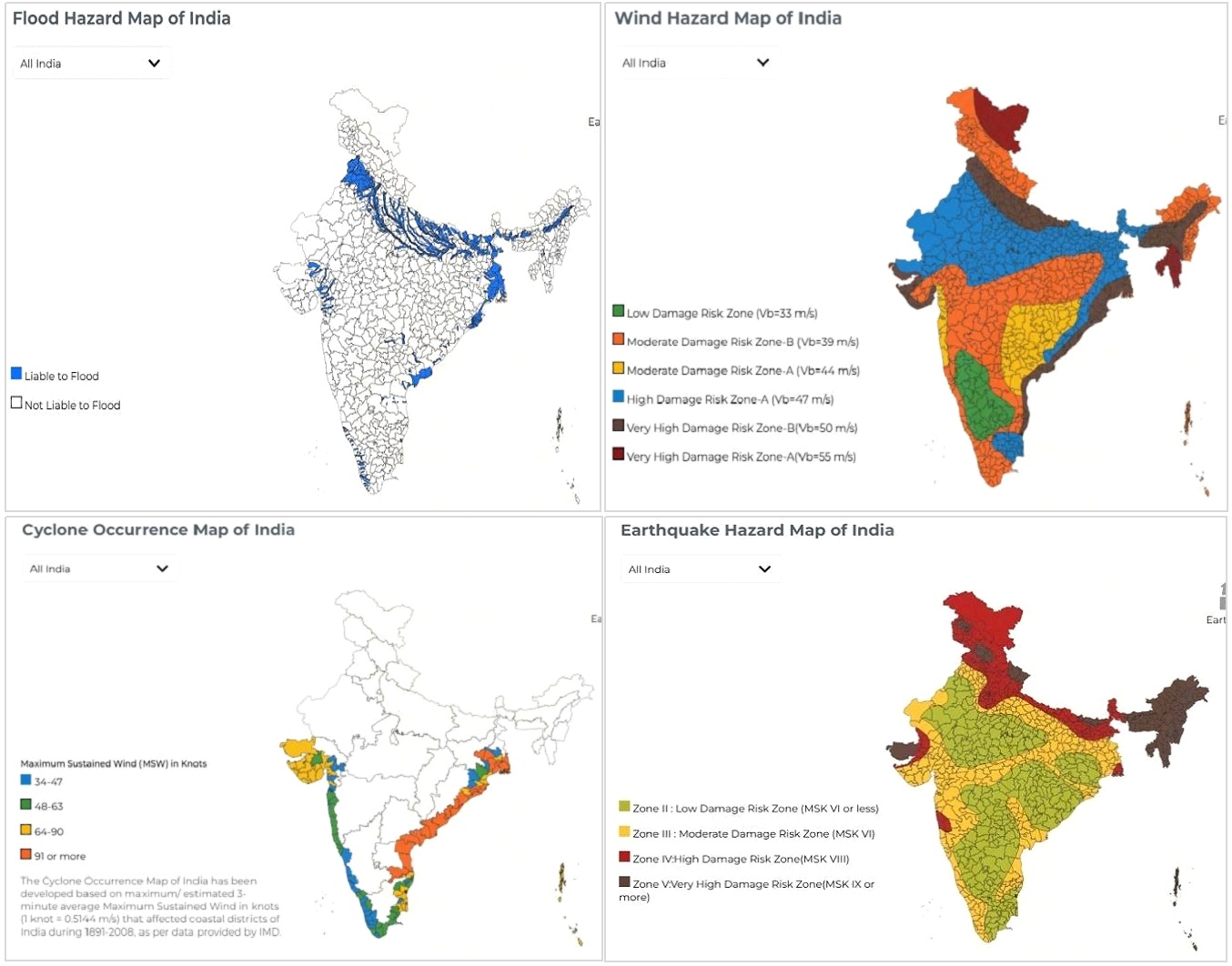
Source: https://iced.niti.gov.in/climate-and-environment/environment/natural-disaster
Changes in climate and increasing global temperature have accelerated and intensified events of disasters. Moreover, many anthropogenic activities such as increase in population, rapid growth in urbanization, expansion of industrialisation, developmental activities in high risk zones and degradation of environment are also responsible for ever increasing incidents of disasters and loss of lives and livelihoods.
According to the International Disaster Database (EM-DAT), from 2001 onward 428 incidents of natural disasters were recorded in India. These disasters cumulatively 114 crore people.
Disaster Affected Population from 2001 to 2025 in India
| Damage | Number |
| Total Deaths | 92,297 |
| Total Injured | 224,983 |
| Total Homeless | 13,671,757 |
| Total Affected | 114,68,79,766 |
Source EM-DAT
The data base of International Disaster Database reveals that, disasters in India in the last 25 years have affected millions of people and about one lakh people died in different disasters. Of these 428 recorded incidents of disasters, overwhelmingly 238 disaster events were in the category of ‘hydrological’ meaning flash flood and mass movement. Another 143 events were related to ‘meteorological’ which includes cold waves, heat waves, hail and storms. Biological, Climatological and Geophysical disasters which include events such as avalanche, bacterial disease, forest fire, GLOF and viral diseases accounts for 47% of total natural disasters in this period. An another report of OECD reveals that of all types of disasters, geophysical and hydrological natural disasters have taken lives of more than one lakh people from 1990 to 2024[2].
Impact of Disasters on Economy
Apart from loss of human life, the exposure and intensity of disasters affect local livelihoods and regional economies in a very significant way. Various studies have observed that in the last few decades the intensity and exposure of natural disasters especially related to climatology and hydrology have expanded resulting in greater economic losses. The sixteenth finance commission of India has found that the exposure to disasters is high in high populated states like Uttar Pradesh, Bihar, Maharashtra, West Bengal and Madhya Pradesh[3]. In another exercise by CEEW to develop a composite disaster index of Indian states found that Assam, Andhra Pradesh, Maharashtra and Karnataka are highly vulnerable to natural disasters. In this list Chhattisgarh, Jharkhand and Punjab are least vulnerable states. Amongst Himalayan states, eastern Himalayan states are more vulnerable compared to western Indian Himalayan states[4].
The loss of livelihood is very common due to natural disasters. Despite disaster mitigation and response funds available the loss due to natural disaster can not be fully compensated as the volume of the loss is exceptionally high. According to a study by OECD the average annual economic loss of India due to disasters from 1990 to 2024 is about 0.4 per cent of its GDP[5]. In another estimate by Swiss Re, India’s economic loss due to natural disasters was nearly USD 12 billion in 2023, which was very high compared to average loss from 2013-22. The estimate observes that India’s annual average economic loss from 2013 to 2022 was USD 8 billion. It further state that of the total economic loss of India in 2023 only about a one-forth was insured[6]. Meaning, the huge economic loss in India due to disasters is un-insured and falls back on affected people pushing them in a more vulnerable condition.
Floods in India are most destructive as it is evident from the EM-DAT database that flood events are more frequent in India compared to other disasters. Of the total 428 disaster events recorded by EM-DAT database, 238 were hydrological from 2001 to 2025. The CEEW study observes that Himalayan states both on western and eastern Indian Himalayan regions are more vulnerable to floods[7]. More recently there has been a surge in incidents of Glacial Lake Outburst Floods in the Himalayan region which includes incidents of Kedarnath flood in 2013 and Sikkim flood in 2023. A joint preliminary assessment of Kedarnath GLOF in 2013 by government of Uttarakhand and Asian Development Bank estimated economic loss of around USD 661 million[8].
Share of Annual Average Economic Losses in India During 2000-2023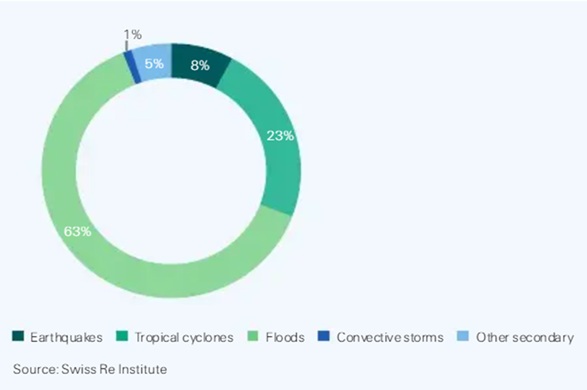
The high number of hydrological disasters is also reflected in higher economic loss. According to an estimate by the Swiss Re institute from 2000 to 2023 of the total economic loss in India, 63% was due to floods. It followed by tropical cyclone (23%) and earthquakes (8%)[9]. There are several other estimates on economic loss due to natural disasters in India. Each of them have different methods of calculation and reference period. Therefore, there is very little consistency in estimates across sources. However, all sources claim that hydrological disasters in India have exceptionally higher exposure compared to other disasters.
India’s Response to Natural Disasters
The Indian Parliament enacted the National Disaster Management Act, 2005 to lay down institutional, legal, financial and coordination mechanisms to address challenges of disasters at national, state, district and local level. The law lays down provision of constitution of National Disaster Management Authority (NDMA) at the national level as an apex body dealing with both natural and manmade disasters in India. The NDMA is headed by the Prime Minister of India and has responsibility to lay down policies, plan and guidelines to respond to disasters in the country and ensure their effective implementation at national, state, district and local level in coordination with subordinate institutions at all levels.
The NDMA is followed by the State Disaster Management Authority (SDMA) at the state level and the District Disaster Management Authority (DDMA) at district level. The SDMA is headed by the chief minister of the state and DDMAs are headed by respective district collectors or district magistrates. The SDMA is responsible to day down state level plans in accordance with NDMA and the DDMAs are responsible for planning, implementing and coordination at the local level.
The law has also provided for creation of the National Institute of Disaster Management as research and capacity development institute at the national level. In collaboration with other research institutions it conducts research on various issues related to disasters. It also has responsibility to conduct capacity development activities for various stakeholders. For specialized search, rescue and response missions during disasters, there is National Disaster Response Force (NDRF) at national level and State Disaster Response Force (SDRF) at state level. The law also provides for creation of a National Disaster Management Fund for smooth functioning and effective disaster response in the country.
The government of India adopted the National Disaster Management Policy in 2009. The vision of the policy is “to build a safe and disaster resilient India by developing a holistic, proactive, multi-disaster oriented and technology driven strategy through a culture of prevention, mitigation, preparedness and response[10].” The disaster management approach adopted by the national policy is divided in the pre-disaster phase and post-disaster phase. The pre-disaster phase includes prevention, mitigation and preparedness. The post-disaster phase includes response, rehabilitation, reconstruction and recovery.
The disaster management Act, 2005 has provided for creation of disaster response funds at national and state level for effective financial flow for disaster response. At the national level it is called National Disaster Response Fund (NDRF) and at the state level it is State Disaster Response Fund (SDRF). Similarly, the act provides for the constitution of National Disaster Mitigation Fund (NDMF) at the union level and State Disaster Mitigation Fund (SDMF) at the state level.
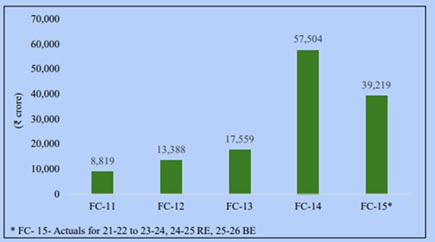
Releases from NDRF and NDMF (Rs. in crore)
Source: https://fincomindia.nic.in/asset/doc/commission-reports/16th-FC/reports/Vol1-Main-Report.pdf
The release of funds from NDRF and NDMF to various states during the finance commission (FC) period 11 to 15 is given in the above chart. It reveals that the release of funds from these two funds has exponentially grown in the last few decades. This growth in release of funds is also corresponding to greater allocation of funds to these two national level funds recommended by the successive finance commissions.
How will the Disaster Fund be Disbursed?
The sixteenth finance commission has substantially updated its formula to decide allocation of disaster management funds to different states. For this time it has relied on two parameters – disaster risk index (DRI) to which 30% weight is allotted and average expenditure of states on disaster management from 2011 to 2024 (70% weight). The total allotted funds to North-eastern and Himalayan states (NEH) will be shared by central and state governments in proportion to 90:10. For other states this proportion is 75:25 where states have to contribute 25% of the total allocated funds. Following is a brief description of two criteria used by the commission to allocate disaster management funds.
Disaster Risk Index
The fifteenth finance commission had developed a Disaster Risk Index (DRI) to allocate central funding for various states. The 16th finance commission commissioned a fresh study by CDRI and Council on Energy, Environment and Water (CEEW) to further refine the DRI. The 16th Finance Commission’s Disaster Risk Index (DRI) is a revised method for allocating disaster-related funds among States. It reflects the internationally accepted view that disaster risk results from the interaction of hazard, exposure, and vulnerability, rather than hazard alone.
Under the earlier FC-15 method, risk was measured using four hazards—cyclone, drought, earthquake, and flood—plus a small category for other hazards. That score was combined with a vulnerability measure based on the proportion of the population below the poverty line. The final allocation was then adjusted using state area, population, and average expenditure. The revised DRI expands the hazard basket to ten disasters: flood, drought, cyclone, earthquake, landslides, hailstorms, cold wave, cloudburst, lightning, and heatwave.
Hazard scores for each State are assigned using reliable national datasets and quintile-based classification. These scores are combined into a composite hazard score using weights based on actual disaster management expenditure.
For exposure, the Commission uses projected population for October 2026, arguing that population is a good proxy for crops, infrastructure, and other exposed assets. It avoids using area separately because area-related factors are already captured in the hazard indicators.
For vulnerability, the Commission replaces poverty-based measures with per-capita income, averaged over 2018–19 to 2023–24 excluding the COVID year. Lower income is treated as indicating higher vulnerability and weaker capacity to manage disasters. Finally, the DRI score is calculated as the product of hazard, exposure, and vulnerability.
The DRI calculated for allocation of disaster management funds for the 16th finance commission period has two contentious issues. One, out of three components to develop the index, the ‘exposure’ component is the dominant and deciding factor. For example, the composite hazard score of Telangana is 7.41 and for Uttarakhand is 7.35. In terms of hazards both of these states are at the same level. But the exposure score of Telangana (4) is double of the exposure score of Uttarakhand (2) as the population of Telangana is higher compared to Uttarakhand. As a result the final DRI score of Telangana is 29.6 and Uttarakhand is just 16.7 points. The insertion of population as a component to decide DRI has disproportionately provided advantage to states with larger populations. Second, of all this, the DRI is weighted only 30% to allocate disaster management funds during the 16th finance commission.
The DRI used by the sixteenth finance commission is far distant from reality. The EM-DAT (a global database of natural disasters) reveals that from 2020 to 2025 total 6.35 crore people were affected and more than 10 thousand people died due to natural disasters. Of this, 10 hilly and north eastern states of India recorded 2.20 crore affected population (34.7% of total affected in India) and 6,890 deaths (63.46% of total deaths in India) during the period.
Table: Impact of natural disaster
| Impact
|
2000-2019 | 2020-25 | ||||
| NEH States | India | Share of NEH States | NEH States | India | Share of NEH States | |
| Total Deaths | 7,662 | 81,439 | 9.4 | 6,890 | 10,858 | 63.46 |
| No of Injured | 7,044 | 1,95,995 | 3.6 | 2,716 | 28,988 | 9.37 |
| No of Affected | 68,62,50,749 | 1,06,94,74,748 | 64.2 | 2,20,67,191 | 6,35,08,278 | 34.75 |
| No of Homeless | 33,60,597 | 1,36,65,492 | 24.6 | 2,615 | 6,265 | 41.74 |
| Total Affected | 68,96,18,390 | 1,08,33,36,235 | 63.7 | 2,20,72,522 | 6,35,43,531 | 34.74 |
Source: Compiled from EM-DAT
The data presented in the above table suggests small states like states in Himalaya and north eastern states who have been allotted very less funds by the 16th finance commission accounts for a very large share of the human loss. Therefore, the DRI developed by the commission and funding formula devised by it are not representative of disaster vulnerability of different states.
Average Expenditure
The 16th Finance Commission proposes that State-wise disaster fund allocation should be based on two components: 30% on the Disaster Risk Index (DRI) and 70% on average expenditure on disaster relief. For the expenditure part, it uses States’ actual spending booked under Major Head 2245 over 2011–12 to 2023–24, excluding the COVID-19 years. From this, the Commission subtracts transfers made to the SDRF, SDMF, and NDRF so that only the State’s own disaster-related spending remains. If a State has directly booked some disaster spending from SDRF in the Public Account, that amount is added back. Then, NDRF releases are subtracted to avoid counting relief already financed by the Centre. The resulting figures are inflation-adjusted and averaged to determine each State’s expenditure base.
This criterion used by the sixteenth finance commission has two problems. First, the calculation of average expenditure index to determine who spent how much from 2011 to 2024. The methodology is designed in such a way that naturally large states with higher budgets will take advantage of it. Small states with very limited resources will have naturally low average expenditure on natural disasters. This methodology once again favors large states irrespective of their disaster hazard index.
The second contention of this criterion is disproportionate weight allocated to the average expenditure in deciding allocation of disaster management funds. This criterion, which gives disproportionate advantage to large states with stronger economies, 70% weight to allocate disaster management funds.
Proposed allocation for Disaster Response by 16th Finance Commission
The 16th finance commission having an award period from 2026-27 to 2030-31 has a mandate to review existing financing of disasters through various funds created at national and state level. The ToR of the commission further empowers them to make appropriate recommendations based on its review. The commission has evaluated financing of disaster in previous FCs, conducted area specific study, reviewed disaster risk index (DRI) and heard representations from state governments, the union government, Union Ministry of Home Affairs and National Institute for Disaster Management.
Based on its elaborate exercise to decide financing of disaster response in next five years, the commission has recommended Rs. 2,04,401 crore for State Disaster Response Funds (SDRFs) and State Disaster Mitigation Funds (SDMFs). This recommendation for five year award period is higher compared to the Rs. 1,60,152 crore recommended by 15th Finance Commission and Rs. 61,219 crore recommended by 14th Finance Commission.
16th Finance Recommendations (Rs. in Crore)
| Name of fund | Share of Union Government | Share of State Government | Total |
| NDRF and NDMF | 79,406 | 79,406 | |
| SDRF | 1,24,732.65 | 38,788.35 | 1,63,521 |
| SDMF | 31,183.20 | 9,696.8 | 40,550 |
| Total | 2,35,321.85 | 48,485.15 |
16th Finance Commission
The fund recommended for national disaster response through SDRFs and SDMFs is shared between the union government and state governments. North Eastern and Himalayan (NEH) states are mandated to contribute 10% to the fund recommended for their SDRFs and SDMFs. Moreover, non NEH states are required to contribute 25% of the total corpus recommended for their SDRFs and SDMFs. In total the central government share to SDRFs and NDMFs is Rs. 1,55,915.85 crore and state governments will cumulatively contribute Rs. 48,485.15 crore.
The FC-16 has also recommended Rs. 79,406 crore for NDRF and NDMF for its award period from 2026-27 to 2030-31. This allocation is also marginally higher compared to Rs. 68,463 crore recommended by FC-15. Funds provided from this national corpus to states require cost sharing by respective states. NEH states are required to contribute 10% of the total amount requested from national funds. However, non NEH states are required to contribute in graded manner depending on size of request and the state contribution can go up to 25% of the total cost.
The recommendation of financing of India’s disaster response by the FC-16 is based on newly created Disaster Risk Index (DRI) and average annual expenditure of states booked from 2011 to 2024 except during covid years 2020-2022. The commission has given 30% weight to DRI and 70% weight to states’ average expenditure. With this calculation, major receivers of disaster response finance in next five years are Maharashtra (Rs. 39,492 crore), Uttar Pradesh (Rs. 20,428 crore), Bihar (Rs. 18,153 crore) and Madhya Pradesh (Rs. 15,596 crore).
Allocation Recommended by FC-16 to Various Categories of States
| State Category | Recommended FC-16 Allocation (Rs. in Crore) |
| 9 Coastal States | 1,02,562 |
| 10 NEH States | 17,434 |
| Other States | 84,405 |
| Total | 2,04,401 |
Source: FC-16 Report
Of the total recommended allocation for states by FC-16, nearly 50% has been allocated for 9 coastal states namely Gujarat, Maharasthra, Goa, Kerala, Tamil Nadu, Andhra Pradesh, Karnataka, Odisha and West Bengal. Himalayan and North Eastern States have received only Rs. 17,434 crore for next five years which accounts to about 8.5% of the total allocation for the award period. Moreover, of the total proposed disbursement allocated by the finance commission, 68.6% (Rs. 1,40,408 crore) has been allocated to just 8 states namely Maharashtra, Uttar Pradesh, Bihar, Madhya Pradesh, Odisha, Rajasthan, Tamil Nadu and Gujarat.
Hits and Misses of FC-16
The 16th Finance Commission has increased the disaster response fund allocation from Rs. 1.60 lakh crore in 15th FC to Rs. 2.04 lakh crore in the award period of sixteenth finance commission. The formula to allocate funds to SDRFs and SDMFs has been modified by the FC-16 compared to its previous commission. In this award period the funds has been allocated based on composite Disaster Risk Index (DRI) and Annual Average Expenditure (AE) calculated based on booked expense by states from 2011 onwards excluding covid years. The weight assigned for AE is as high as 70% compared to just 30% weight for DRI. This section attempts to highlight a few hits and misses by the sixteenth finance commission to allocate funds for India’s disaster response.
The Allocation
The central government in its representation to the 16th Finance Commission had requested to set the annual expenditure on disaster response to 0.15% of base year GDP. The final allocation for the first award year 2026-27 recommended by the FC-16 is Rs. 36,990 crore for states and Rs. 14,370 crore for national corpus. The total allocation for the first award year is Rs. 51,360 crore, which will increase at the rate of 5% every year. This expenditure comes around 0.15% of India’s real GDP if it is estimated around Rs. 322 lakh crore in FY 2025-26[11].
In contrast to estimated annual economic loss due to disasters in India, these numbers are insignificant. An estimate by OECD, India’s annual average economic loss to disasters from 1990 to 2024 was about 0.4% its GDP[12]. Another estimated by Swiss Re Institute reveals that from 2013 to 2022, India’s average annual economic loss to disaster was 8 billion USD which is roughly equal to Rs. 7.3 lakh crore per year[13]. A single event of GLOF in Kedarnath (Uttarakhand) in 2013 estimated washed away wealth equivalent to 661 USD or about Rs. six thousand crore. In the context of huge economic loss, the annual expenditure by the government is significantly low. In other words, disaster affected people have to bear most of the reconstruction and rehabilitation costs post-disaster due to highly acute availability of public funds.
Review of Allocation in FC-15
The 16th Finance Commission has kept the previous pattern of expenditure booked by states and union governments to decide allocation of funds for disaster resilience in its award period from 2026 to 2031. During the FC-13 award period more than 98% of the union’s share to the state was transferred. It improved in the FC-14 award period and more and 99.4% of the Union government’s share to the state was transferred. The data available for the first four years of FC-15 reveals that the union government has transferred 93% of its share to states. Many states complained to the FC-16 that there is delay in transfer of funds from the union government to their SDRFs and SDMFs. They further complained that such delay is adversely affecting their work to promptly respond to disasters. However, the union government argued that the delay in fund transfer to states is attributed to their huge unspent corpus.
State of NDMF and NDRF during 15th FC award period
| Name of fund | Recommended by FC | Allocated by Union Government | Actual Release by Union Government |
| NDMF | 13,693 | 8,269.02 | 1,091.81 |
| NDRF | 54,770 | 60,770.00 | 19,667.00 |
| Total | 68,463 | 69,039.02 | 20,758.81 |
Source: 16th Finance Commission Report, Vol-I
The FC-16 report gives details of utilization of national funds (NDRF and NDMF) during the FC-15 award period. Data available up to July 2025 reveals that only Rs. 20,758 crore was spent against Rs. 68,463 recommended by the FC-15. The utilization of the national fund is as low as 30% of recommended allocation. The utilization of the national disaster mitigation fund (NDMF) is even less. The data suggests that only 8% of the recommended fund in the last five years was spent by the union government for disaster mitigation. Many states have also complained that grants from NDMF and NDRF were delayed in the FC-15 award period. The union government has attributed this delay to the delay in issuance of guidelines for disbursement and utilization of funds. India is spending too little on disaster response against economic loss. Yet, the FC-16 has not given any concrete solution (barring asking central and state governments to use IT infrastructure for coordinated action) to ensure timely disbursement of funds to states.
Equitable Distribution of Funds
The total allocation for the disaster response fund has increased by 27.6% compared to allocation awarded by the FC-15. However, six states will have less funds compared to the last finance commission’s award period. These states are Arunachal Pradesh, Jharkhand, Punjab, Tripura, Uttarakhand and Andhra Pradesh. Arunachal Pradesh has observed the highest decline in its share in the disaster response fund from Rs. 1536 crore in FC-15 to just Rs. 684 crore in FC-16.
The FC-16 has been developed as a composite Disaster Risk Index (DRI) that combines hazards in a state, disaster exposure (population) and vulnerability (per capita income score). However, this mammoth exercise of calculating DRI has only 30% weight in deciding states’ share in the undivided pool. Another 70% weight has been given to states’ history of expenditure on disaster response starting from 2011. The population score in the DRI has been influential in deciding the total DRI score of a state. For example, both Assam and Rajasthan have the same hazard score of 9.9 but the allocation for Rajasthan is Rs. 12,281 crore and for Assam it is Rs. 5,825 crore. Similarly Uttarakhand and Himachal Pradesh have similar hazard scores but their allocation is Rs. 5,504 crore and Rs. 2,980 crore.
Allocation of Disaster Management Fund by FC-15 and FC-16
| State Category | FC-15 Allocation | FC-16 Allocation | Absolute Difference | Difference in % |
| Coastal States | 76,737 | 1,02,562 | 25,825 | 33.6 |
| NEH States | 16,472 | 17,434 | 962 | 5.8 |
| Other States | 66,944 | 84,405 | 17,461 | 26.08 |
| Total | 1,60,153 | 2,04,401 | 44,248 | 27.6 |
Source: compiled from FC-15 and FC-16
The allocation for disaster financing has not increased uniformly across the state. Coastal states have observed an increase of 33.6% in their share for disaster funds. However, NEH states have only observed an increase of 5.8% in their allocation during the current award period. This allocation must be seen in increasing devastating events of floods and GLOFs in the Himalayan and north eastern states in the last couple of decades. NEH contributes a lesser percentage to their disaster fund corpus compared to other states, but they need more funds in the wake of their fragile geology and increasing incidents of GLOFs and Floods. These events will only increase because of the disproportionate impact of global warming in the Himalayan states.
Integrated Approach
Disasters (both natural and manmade) are the result of excessive human interventions and increasing anthropogenic pressures. The conventional development has increased this pressure on natural resources. While the global climate negotiations are persuading countries to go for net zero in order to reduce anthropogenic pressure on natural wealth and climate. Yet, the most developmental approaches across the globe are highly concentrated around wealth creation at the cost of nature and climate. The finance commission report is also one such manifestation of prevailing economic culture. Of six criteria finalized by the FC-16 for horizontal distribution of funds, 52.5% weight is given to economic indicators (per capita GSDP distance and contribution to GDP). Of these six horizontal criteria, only ‘forest and eco system’ criteria attempts to incorporate sustainability issues. However, only 10% weight has been given to this criterion for fund disbursement.
The fourteenth finance commission for the first time introduced the ‘forest and ecosystem’ as criterion to decide horizontal distribution of taxes. It had awarded 7.5% weight to it, which was further increased to 10% in the fifteen and sixteenth finance commission. Forests are crucial in minimizing impact of hydrological and climatological disasters. The introduction of this criteria by the FC-14 has produced good results.
India’s Forest Cover
| Forest Category | ISFR-2017 | ISFR-2023 |
| Very Dense Forests | 88,403 | 92,585 |
| Moderately Dense Forests | 2,98,920 | 2,98,385 |
| Open Forests | 2,89,029 | 2,93,970 |
| Total | 6,76,253 | 6,84,749 |
Source: Compiled from ISFR-2017 and ISFR-2023
An analysis of India’s forest cover based on data provided by periodic ‘India’s State of Forest Report’ for 2017 and 2023 reveals that the very dense forests in India have marginally increased. The total forest cover which includes open forest has also increased in these years. Moreover, most states have shown growth in their dense forest which comprises forest with canopy density more than 40 per cent. However, some states such as Tamil Nadu, Arunachal Pradesh, Tripura and Nagaland have shown decrease in their total dense forests. The data shown in the above table reveals that the inclusion of forest as a criterion for disbursement of central pool has positive impact. There is a need to continue this and strengthen it further. However, the FC-16 has incorporated the area of open forest in deciding funds to be allotted to states based on this criterion. In the FC-14 and FC-15 only dense and moderate dense forest area was considered for deciding their criterion. The inclusion of open forest to disburse the central pool may demoralize states with high dense forests such NEH states.
Conclusion
Incidents of natural disasters have grown significantly in the last few decades. Various studies on climate change predict that these incidents will further increase due to increase in extreme weather events and global warming. India is vulnerable to a number of climate induced natural disasters. Data related to disasters in the last two and half decades suggests that the incident of disasters and their impact on lives and livelihoods is exponentially increasing.
The Sixteenth Finance Commission has increased the allocation for disaster management from ₹1,60,152 crore during 15th finance commission to ₹2,04,401 crore for the five-year period from 2026 to 2031. In addition, another ₹79,406 crore has been allocated for national-level disaster management funds. In total, the Finance Commission has earmarked ₹2,83,807 crore to finance disaster response and mitigation activities over the next five years. Annually, India’s public expenditure on disaster management will amount to around 0.15% of its GDP[14].
The allocation proposed by the 16th finance commission is based on its updated methodology but it looks the allocation of funds to states does not corroborate with disaster vulnerability of different states. The approach in allocation of disaster funds must be on principle of equitability rather than a formula. In order to improve funding allocation to different states as per their disaster vulnerability this article recommends following policy level action and decisions:
- The disaster risk index (DRI) developed by the sixteenth finance commission does not resonate with the actual damage and loss in different states. For example the north eastern and hilly states have recorded more than 63% of the total deaths due to natural disaster in India and above 34% total disaster affected people from 2020 to 2025, they were allotted only 8.5% of the total funds. The population of the state as a key multiplier in the formula of DRI increases the index score of large states. This makes the DRI subjective and creates space for additional funding to large states irrespective of their hazard vulnerability. The DRI must be created based on actually affected people, economic loss, biodiversity loss and hazard index.
- The 70% weightage given for average expenditure on disaster management in the past is also lopsided in favour of large states with larger budget size. Naturally large states will have higher scores due to their larger budget size. Moreover, the weightage given to this criterion to allocate funds to different states is un-reasonably high. To encourage state governments to spend more money on disaster management and mitigation, this criterion is important but this should be re-created to keep objectivity of the score in mind.
- North eastern and hilly states (NEH) are highly vulnerable as demonstrated in this paper using the EM-DAT All of these states are small in size and population. However, they record the highest social, economic and ecological cost due to natural disasters. These states must be given advantage in order to secure their biodiversity and natural wealth.
- Evaluation of 15th Finance Commission allocation analysis suggests that actual expenditure of disaster management funds at the central level and state level is low. While the impact of disasters is on rise, we are unable to spend our allocated funds to respond, rescue and reconstruct. Many states have also complained that the central government delays disbursement of funds. The 16th finance commission has suggested some good steps to resolve this issue. Moreover, funds disbursement in this case may also be linked to disaster vulnerability of different states in different seasons. For example, some funds to north eastern states may be released before the rainy season begins. Similarly funds to western Himalayan states may be released before commencement of monsoon.
While the enhanced allocation for disaster management is a welcome step, it is crucial to adopt a more comprehensive and equitable approach. The funding must resonate with the actual impact of disasters on society, economy and ecology.
References
[1] National Policy on Disaster Management- 2009, Government of India: https://ndma.gov.in/sites/default/files/PDF/national-dm-policy2009.pdf
[2] OECD (2025), Economic Outlook for Southeast Asia, China and India 2025: Enhancing Disaster Risk Financing, OECD Publishing, Paris, https://doi.org/10.1787/6fc95782-en
[3] 16th Finance Commission of India, vol-2: https://fincomindia.nic.in/asset/doc/commission-reports/16th-FC/reports/Vol2-Annexures.pdf
[4] Mohanty, Abinash, and Shreya Wadhawan. 2021. Mapping India’s Climate Vulnerability – A District Level Assessment. New Delhi: Council on Energy, Environment and Water.
[5] OECD (2025), Economic Outlook for Southeast Asia, China and India 2025: Enhancing Disaster Risk Financing, OECD Publishing, Paris, https://doi.org/10.1787/6fc95782-en.
[6] Swiss Re Institute (2025), India’s Economy and Insurance Market: Growing Rapidly, mind the risks hotspots: https://www.scribd.com/document/903216493/2025-01-14-Swiss-Re-Institute-Expertise-Publication-India-Economy-and-Insurance-Market
[7] Mohanty, Abinash, and Shreya Wadhawan. 2021. Mapping India’s Climate Vulnerability – A District Level Assessment. New Delhi: Council on Energy, Environment and Water: https://www.ceew.in/publications/mapping-climate-change-vulnerability-index-of-india-a-district-level-assessment
[8]Rapid Joint Assessment Report of Kedarnath Floods in 2013, Asian Development Bank and Government of Uttarakhand: https://www.adb.org/sites/default/files/linked-documents/47229-001-sd-01.pdf
[9] Swiss Re Institute (2025), India’s Economy and Insurance Market: Growing Rapidly, mind the risks hotspots: https://www.scribd.com/document/903216493/2025-01-14-Swiss-Re-Institute-Expertise-Publication-India-Economy-and-Insurance-Market
[10] Government of India, National Disaster Management Policy- 2009: https://ndma.gov.in/sites/default/files/PDF/national-dm-policy2009.pdf
[11] PRESS NOTE ON NEW SERIES OF GROSS DOMESTIC PRODUCT (GDP) ESTIMATES WITH BASE YEAR 2022-23 Dated 27th February, 2026https://www.mospi.gov.in/uploads/latestReleases/latest_release_1772189865181_f040336d-bc57-4aed-b80f-586d9ccb279e_Press_Note_on_New_Series_of_GDP_Estimates_with_Base_Year_2022-23_27022026.pdf
[12] OECD (2025), Economic Outlook for Southeast Asia, China and India 2025: Enhancing Disaster Risk Financing, OECD Publishing, Paris, https://doi.org/10.1787/6fc95782-en:
[13] Swiss Re Institute (2025), India’s Economy and Insurance Market: Growing Rapidly, mind the risks hotspots: https://www.scribd.com/document/903216493/2025-01-14-Swiss-Re-Institute-Expertise-Publication-India-Economy-and-Insurance-Market
[14] 16th Finance Commission of India, vol-2: https://fincomindia.nic.in/asset/doc/commission-reports/16th-FC/reports/Vol2-Annexures.pdf
Photo- harish-bharti-Cj0539-PSvY-unsplash