


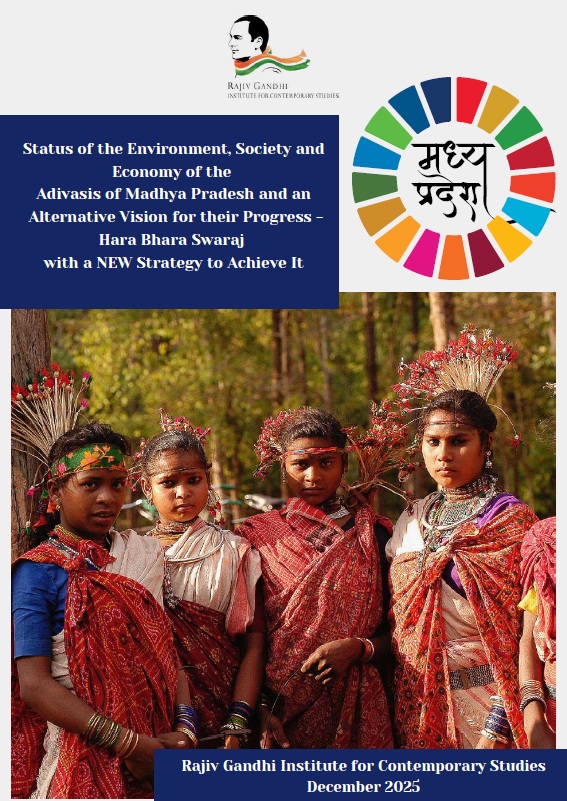
The Madhya Pradesh SENSE Report presents a concise appraisal of the environment, society and economy of Adivasi communities in Madhya Pradesh and proposes Hara Bhara Swaraj — a NEW strategy (Nature regeneration; Enabling human, social and institutional development; and Well-th creation) — as an alternative pathway to sustainable and inclusive progress.
The report documents severe environmental stresses: declining water security despite traditional systems (paat, ponds), fragile forests and biodiversity under extraction pressure, and rising land degradation and desertification affecting large tracts of agricultural and forested land; climate change (jalvayu) is already reducing yields and altering livelihoods. Socially, it highlights poor health outcomes (malnutrition, high MMR/IMR, endemic diseases), low educational attainment with rising dropout rates, and weak institutional reach in many tribal areas. Economically, dependence on forest-based livelihoods, predominantly rainfed agriculture, limited market access and constrained finance trap communities in chronic vulnerability.
Building on indigenous practices (bewar, paat, sacred groves, terraced cultivation, medicinal-plant knowledge), the report recommends urgent public investment in nature regeneration (jal, jangal, jameen), strengthening culturally rooted health and education services, and promoting tribal community-owned enterprises and socially and environmentally responsible entrepreneurs so regeneration translates into inclusive “well-th.”
Key Words: Biodiversity, Water (Jal), Forests (Jangal), Land degradation (Jameen), Climate change (Jalvayu), Paat, Bewar, Health, Education, Forest-based livelihoods, Market access, Hara Bhara Swaraj, NEW strategy, Well-th, People’s Protected Areas.
Status of the Environment, Society and Economy of the Adivasis of Madhya Pradesh
Send download link to: