
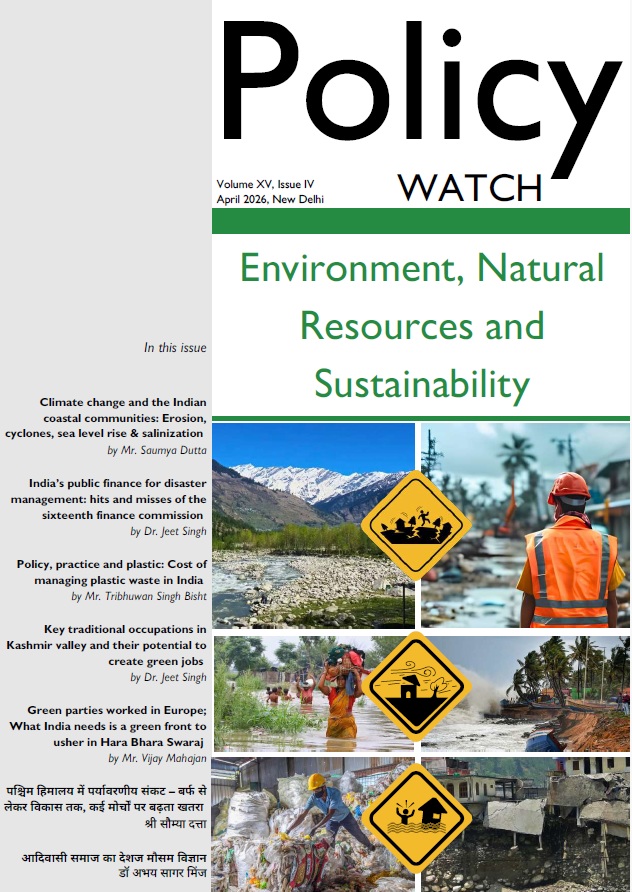
This issue of Policy Watch is dedicated to the fourth theme – Environment, Natural Resources and Sustainability – and has been compiled by Dr. Jeet Singh, Head of Research, RGICS, and the undersigned. It features seven articles covering a range of critical topics, including disaster management, climate change, and the impact of climate change on coastal regions, green jobs, and plastic waste.
The first article, by senior climate expert Mr. Saumya Dutta, examines the changing patterns of climate change in India’s coastal regions and their ensuing social and economic impacts. Mr. Dutta elaborates on how cyclone patterns in the Arabian Sea are changing rapidly, a phenomenon for which the west coast remains largely unprepared. The article delves into the science behind the rising frequency, duration, and impact of cyclones on both the eastern and western coasts of India. It also explains how these rapid changes are affecting the livelihoods of fish workers. He concludes by emphasizing the need to understand the interplay between sea-level rise, coastal erosion, increased storm surges, the three mechanisms of cyclone damage, and the growing number of cyclones.
The second article, authored by Dr. Jeet Singh, focuses on the disbursement of disaster management funds to states as proposed by the Sixteenth Finance Commission. This piece highlights the Commission’s progressive decision to improve disaster management funding while also pointing out key shortcomings in its report. It analyzes actual disaster incidents and the associated economic and human losses across different states, drawing parallels with the proposed disbursement mechanism. More specifically, the article critically examines the two criteria adopted by the Commission for fund allocation: the average past expenditure on disasters by a state, and the disaster risk index.
Our third article is adapted from the recently published India’s State of Environment – 2026 report by Down To Earth. This research article by Mr. Tribhuwan Singh Bisht highlights key policy gaps related to plastic pollution and the ground realities of waste management. The study analyzes the cost of plastic recycling in diverse cities: Dharamshala (in the Himalayas), Port Blair (in the Andaman & Nicobar Islands), Pune, and Indore. It finds that recycling costs are significantly higher in island and hilly cities compared to cities like Pune and Indore. The article concludes that the Extended Producer Responsibility (EPR) policy must be redesigned to account for these geographical and institutional factors.
Dr. Jeet Singh has authored the fourth article, which explores the potential for green jobs within key traditional occupations in the Kashmir Valley. The article attempts to strike a balance between environmental conservation and economic growth in sectors such as dairy, horticulture, fisheries, and weaving. Through four distinct case studies, it seeks solutions that provide decent wages for workers in these sectors while conserving their foundational natural resources – water, forests, and soil.
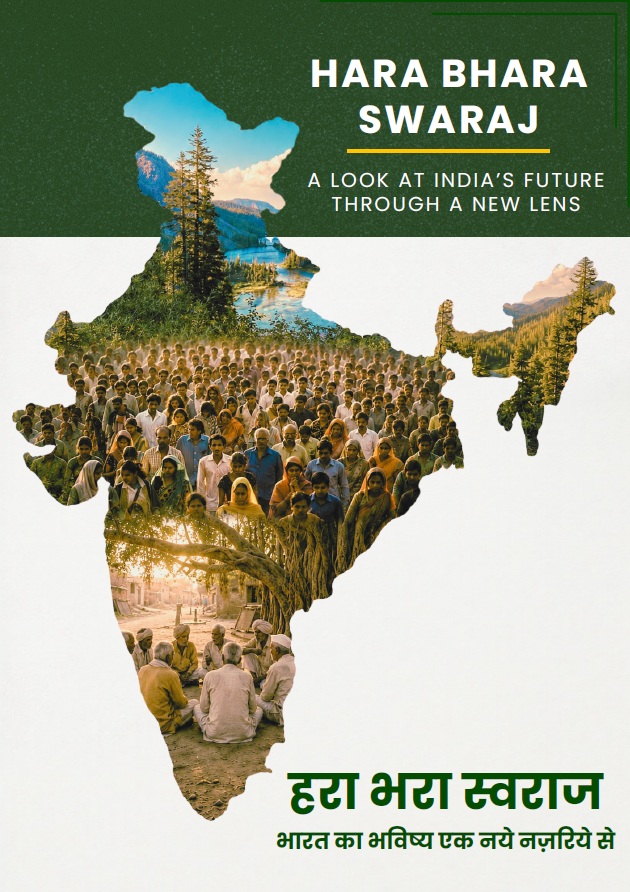
The fifth article is a compilation by Mr. Vijay Mahajan on Green Parties around the world, based on public sources on the web. (In the appendix, we describe some fledgling attempts in India to form Green Parties). Given that India’s national, state and even municipal candidates are elected based on the principle of first past the post (or largest number of votes, whether majority or not) in a territorial constituency, and a majority of elected representatives from a single party or coalition form the government, a Green Party may not be the answer. This is because even if the Green Party candidates got 10% votes, they would not win any seats. Instead, we argue that a Green Front should be established that links movements, experts, unions, and voter‑education efforts. This Green Front should influence the existing mainstream political parties to adopt the ushering in of “Hara Bhara Swaraj” (green, fulfilling, self-governance), as a common national agenda.
The sixth and final article is again based on a conversation with climate expert Mr. Saumya Dutta. Written in Hindi, this article explores the multifaceted climate crisis in the Western Indian Himalaya and its impact on local society, ecology, and economy. It discusses both global and regional factors responsible for changes in glaciers, forests, water systems, snow cover, wildlife, and agriculture in the region.
We also carry an article in Hindi by Dr. Abhay Sagar Minj about how our Adivasis were able to forecast the weather by observing the flora and fauna around them.
We hope our readers find this issue on Environment, Natural Resources and Sustainability both informative and enriching.
Policy Watch: Environment, Natural Resources and Sustainability - April 2026
Send download link to: