The Rajiv Gandhi Institute for Contemporary Studies (RGICS) works on five themes:
- Constitutional Values and Democratic Institutions
- Governance and Development
- Growth with Employment
- Environment, Natural Resources and Sustainability
- India’s Place in the World
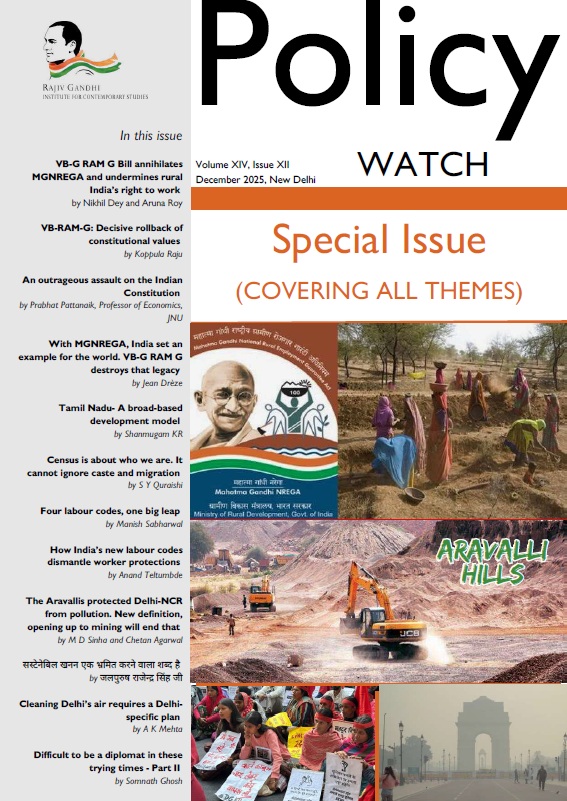
We bring out the monthly Policy Watch on each of these themes sequentially, and every sixth issue is a Special Issue, where we carry articles from each theme. This is a special issue in which we carry articles on each theme. It has been put together by Prof Somnath Ghosh, Senior Visiting Fellow, RGICS.
The on-going exercise in Parliament to substitute Mahatma Gandhi National Rural Employment Guarantee Act with VB – RAM – G (which has just been passed by the Lok Sabha) has created a huge storm. We have chosen three short articles on this topic for the theme Constitutional Values and Democratic Institutions.
The first article, “VB-G RAM G Bill annihilates MGNREGA and undermines rural India’s right to work” is by Nikhil Dey and Aruna Roy, founder members of the Mazdoor Kisan Shakti Sangathan (MKSS), who played a major role in the enactment of the MGNREG Act. They acknowledge while MGNREGA has had many problems and much could have been strengthened within its own framework, it has served rural India well and served India extremely well in times of economic distress. Then, by referring to just four provisions of the proposed law, they claim how false the statutory guarantee is; and therefore this Bill must be comprehensively rejected.
The next article is by K Raju, who as Principal Secretary, Rural Development, Government of Andhra Pradesh was one of the first implementers of NREGA. According to him, the proposed legislation, VB – RAM – G, is a decisive rollback of constitutional values of dignity, livelihood security, and decentralisation as it dismantles NREGA’s rights‑based entitlement and replaces it by a controlled employment scheme.
The next article is by JNU Professor of Economics Prabhat Pattanaik. He calls the G RAM G Act as an outrageous assault on the Constitution and explain how it violates both the right to livelihoods of the poor and also the principle of federalism. Moreover the way the Act was rushed through was a travesty of Parliamentary processes.
The last article under the theme is by Jean Drèze, who has been a long term advocate of the rights of the poor and the landless. In “With MGNREGA, India set an example for the world. VB-G RAM G destroys that legacy”, Drèze says that far from revamping India’s employment guarantee, the proposed Bill sinks it by demotivating the states and disempowering the workers.
The next two articles are under the theme, Governance and Development. In “A broad-based development model”, Shanmugam KR informs us that a balanced development strategy, integrating rapid industrialisation with strong social welfare and sustainability initiatives, has positioned Tamil Nadu as a role model for other States.
The next article is on the equally contemporary issue of census and caste. In “Census is about who we are. It cannot ignore caste and migration”, former Chief Election Commissioner of India, S Y Quraishi avers that announcing a Census without specifying whether it includes caste suggests indecision or deliberate ambiguity; and while both are problematic, Census 2027 should enumerate caste comprehensively.
Under the theme, Growth with Employment, we have once again two articles. In “Four labour codes, one big leap”, Manish Sabharwal of Teamlease Services says that they make India a better habitat for good jobs. Apart from reducing redundancies, the codes expand social security to gig and unorganised workers, remove unfair restrictions on women, and enable portability of benefits for inter-state migrant workers.
In sharp contrast, in the next article, Anand Teltumbde, a former CEO of Petronet India and a professor at IIT Kharagpur presents a starkly different picture. From labour’s perspective, he flags multiple regressive aspects in the four codes. Some of these relate to ease of retrenchment, strangling of strike, permanent precarity arising out of introduction of fixedterm employment provision, overtime illusion, and job insecurity.
In the penultimate theme on Environment, Natural Resources and Sustainability, we have two articles on the issue of pollution – something that is grabbing headlines on a daily basis. First we present “The Aravallis protected Delhi-NCR from pollution. New definition, opening up to mining will end that” by two specialists, M D Sinha, retired Principal Secretary, Govt. of Haryana, and Chetan Agarwal who has worked extensively on the Aravallis. They hold that excluding hills below 100 metres in the Aravallis would be an ecological disaster for entire NCR, creating even more gaps in the Aravalli shield, further increasing the particulate matter in the air leading to cascading effect on pollution and desertification.
The next article titled सस्टेनेबिल खनन एक भ्रमित करने वाला शब्द है by जलपुरुष राजेन्द्र सिंह is the hindi version of the above article on Aravallis.
The next article by AK Mehta. In “Cleaning Delhi’s air requires a Delhi-specific plan”, the author, a former chief secretary, J&K, and ex-chairman, CPCB holds that Delhi’s smog is a test of governance, science, and shared will; and Government data show that the current framework, even if fully enforced, cannot deliver clean air. The fix, Mehta says, lies in prediction, participation, intensity of airshed-wide action, and the will to act before the air turns toxic.
Finally, under the theme India’s Place in the World, we present the concluding part of the paper “Difficult to be a Diplomat in these Trying Times” by Somnath Ghosh. Here, he focusses on the issues that have significant turbulence emanating from Bangladesh, Pakistan, the Gulf region, and Turkey and Azerbaijan. Only this time, the dynamics of power play – itself an outcome of economic and military might – has been trumped by intense hostility towards India from Bangladesh and Pakistan, potentially making the situation precarious. He also seeks to unravel the significance as well underlying anxieties of Putin’s recent visit to India.
Policy Watch: Special Issue - December 2025
Send download link to: