
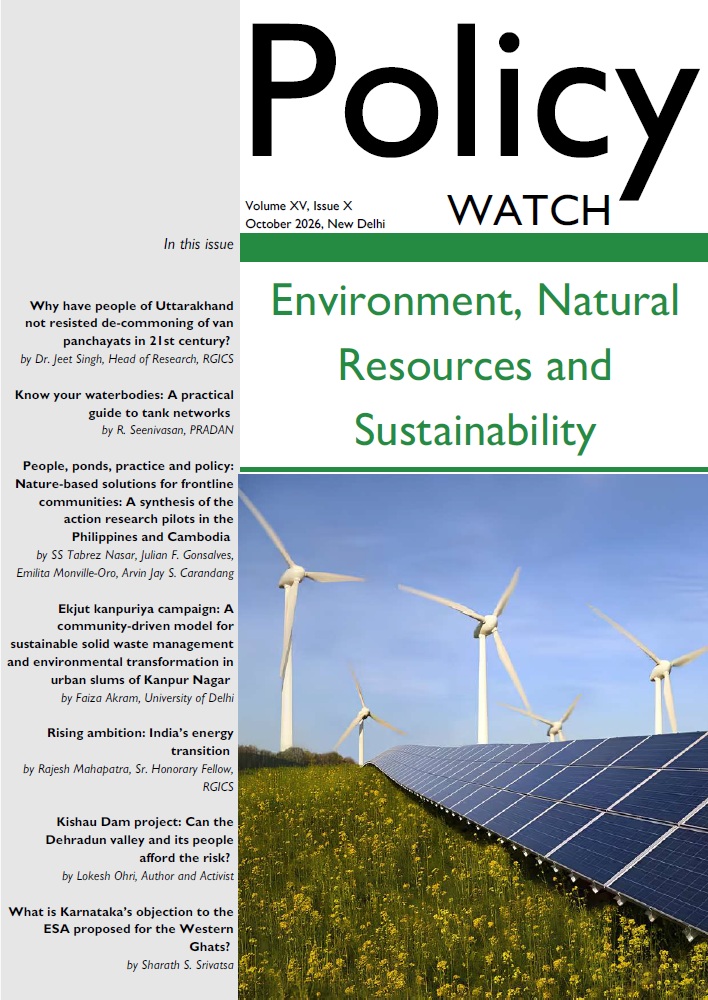
This issue of Policy Watch, themed “Environment, Natural Resources and Sustainability,” carries seven articles which explores interactions of social and ecological systems in different contexts. Landscape and people it covers includes the Himalaya, Western Ghat, Plains of Ganga and South East Asia.
The first article by Dr. Jeet Singh, Head of Research, RGICS elaborate on gradual centralization and de-commoning of Van Panchayats in Uttarakhand.
This article further explores that apparent contradiction, examining how expectations surrounding statehood, changing subsistence livelihoods and outmigration have influenced collective action and people’s relationship with community forests.
Mr. S. Seenivasan from PRADAN in the second article provides guidelines for restoration of Tanks in Tamil Nadu. This article introduces the functioning of tank networks and provides practical guidance on assessing damage, planning rehabilitation, using tank silt and coordinating with communities and government departments while preserving established technical standards.
Third article is by Mr. Tabrez Nasar, Julian F. Gonsalves, Emilita Moville-Oro and Arvin Jay S. Carandang on nature based solutions for frontline
communities in Philippines and Cambodia. Drawing on five action research pilot sites, this article examines how nature-based solutions can help communities respond.
It brings together field experiences involving diversified farming, locally available inputs, women-led enterprises and ecosystem conservation to explore pathways towards more resilient aquaculture and stronger local institutions.
Fourth article in this issue of the Policy Watch by Ms. Faiza Akram, a student of Delhi University has documented a community driven model for sustainable soild waste management in urban slums of Kanpur (UP) through Ekjut Kanpuriya Campaign. This article examines its work across seven settlements, focusing on community ambassadors, women’s leadership, composting, creative reuse and municipal engagement. It explores how everyday participation can strengthen both environmental practices and residents’ ability to secure better public services.
Fourth article in this issue of the Policy Watch by Ms. Faiza Akram, a student of Delhi University has documented a community driven model for sustainable soild waste management in urban slums of Kanpur (UP) through Ekjut Kanpuriya Campaign. This article examines its work across seven settlements, focusing on community ambassadors, women’s leadership, composting, creative reuse and municipal engagement. It explores how everyday participation can strengthen both environmental practices and residents’ ability to secure better public services.
The sixth article by senior environmental and cultural activist Mr. Lokesh Ohri comments on social, cultural and ecological consequences of revival of the Kishau Dam project on the Tons River in Dehradun valley. This article questions the adequacy of project planning and asks whether the region’s ecological and social costs have received sufficient consideration.
The seventh and final article has been reproduced from the Hindu discusses question about conservation boundaries, livelihoods, land rights and the treatment of inhabited landscapes of Western Ghats’s Ecologically Sensitive Area in Karnataka. Mr. Sharath S. Vrivatsa in this article explains the Kasturirangan Committee’s recommendations, compares them with the Gadgil report and examines Karnataka’s demand for ground-level verification and stakeholder consultation before the proposed boundaries are finalised.
Policy Watch: Environment, Natural Resources and Sustainability – October 2026
Send download link to: