
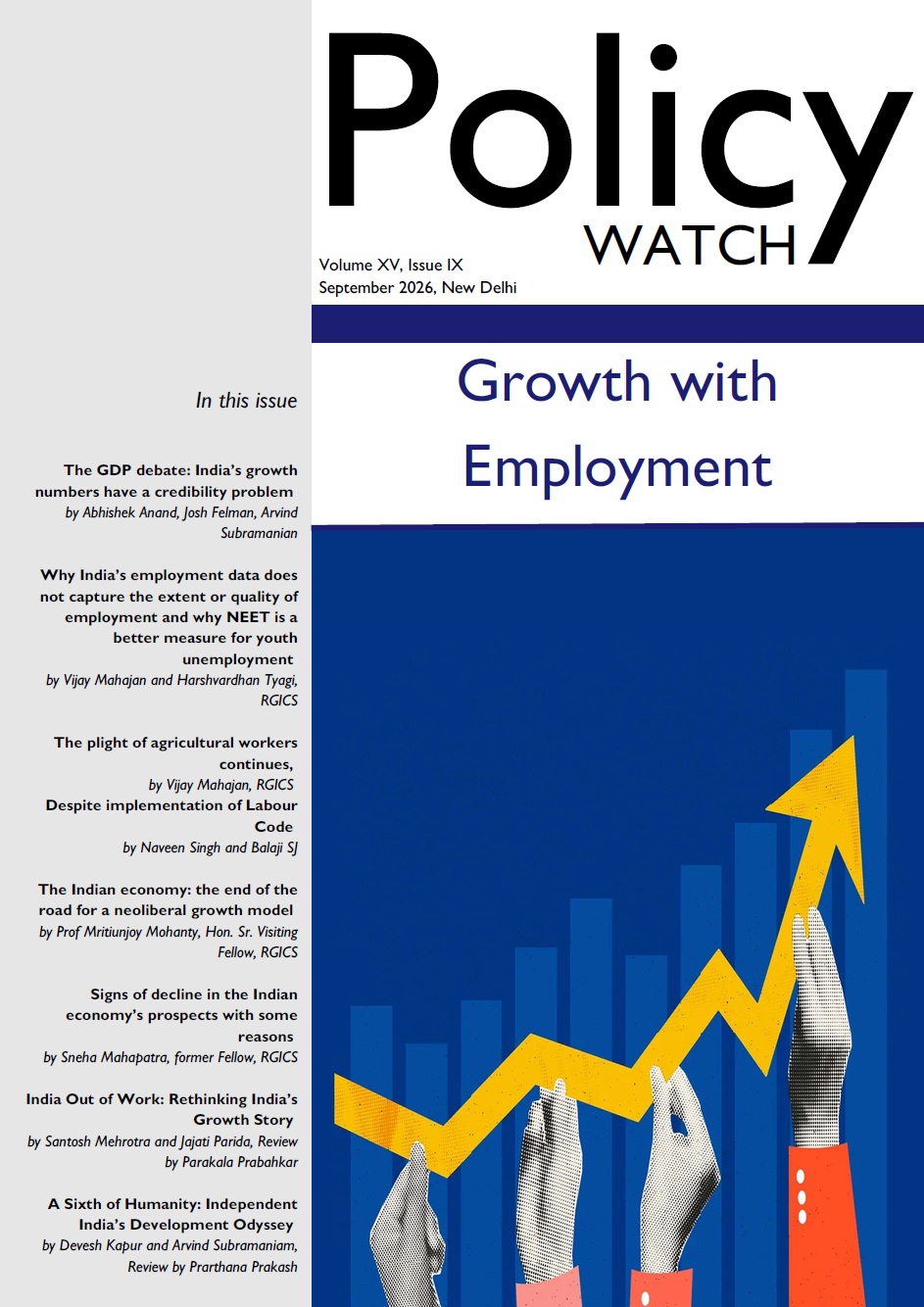
This issue of Policy Watch, themed “Growth with Employment,” examines whether India’s high headline GDP growth is translating into employment, rising wages and improved living standards. Across its articles and book reviews, a central concern emerges – economic growth figures do not necessarily reflect the economic realities experienced by the majority of Indians.
The issue begins with the debate over the credibility of India’s GDP data. Former Finance Secretary Subhash Garg questioned whether recent growth estimates were overstated because of changes that reduced the previous year’s output. Abhishek Anand, Josh Felman and Arvind Subramanian acknowledge that the Ministry of Statistics and Programme Implementation may have followed accepted technical procedures, but argue that the credibility of official statistics has suffered because of delayed and disputed datasets, including the Census and consumption surveys. They also point to concerns about COVID-19 mortality estimates and unusually high reported GDP growth during the demonetisation period. They call for greater transparency, particularly through publication of the complete “Sources and Methods” document explaining how GDP is calculated and revised.
The second article examines the measurement of youth unemployment. Vijay Mahajan and Harshvardhan Tyagi explain the limitations of the usual status, current weekly status and current daily status measures. Young people who are neither working nor actively seeking or available for work are classified as being outside the labour force rather than unemployed. The authors argue that the proportion of youth who are NEET (Not in Employment, Education or Training) is a more comprehensive indicator because it captures both unemployed youth and those outside the labour force who are not studying or training. India’s relatively low measured unemployment rate therefore does not necessarily indicate a healthy youth labour market. Many young people may remain outside the workforce because suitable employment opportunities are unavailable.
The issue then focuses on stagnant rural wages. Vijay Mahajan shows that real wages of rural workers broadly stagnated between 2014–15 and 2022– 23. After accounting for inflation, wage gains were extremely limited, with the COVID-19 period causing an additional setback.
This contrasts sharply with the strong real-wage growth recorded between 2006–07 and 2014–15. Agricultural labourers have been particularly affected, while slow wage growth in non-farm rural occupations has increased the vulnerability of landless workers who depend on construction, transport, services and migration.
Naveen Singh and Balaji SJ examine the implications of the Code on Wages, 2019. While universal minimum wages could improve worker welfare and equity, they may also increase costs, accelerate mechanisation and put pressure on small farmers. The authors therefore argue that wage reforms should be integrated with social security and agricultural policies to support both workers and employers.
Prof. Mritiunjoy Mohanty places these developments within a broader critique of India’s growth model. He argues that high GDP growth has increasingly failed to benefit the majority because real wages have stagnated even as labour productivity has risen substantially. Educated youth face particularly severe unemployment, while agriculture has once again absorbed labour because of insufficient non-farm employment. Weak domestic private investment, despite increasing outward investment, further threatens the sustainability of growth.
Sneha Mahapatra identifies additional warning signs, including deficient rainfall, reduced agricultural prospects, slowing manufacturing and services, weaker FDI, declining bank-credit growth and limited fiscal space. Drawing on earlier research, she argues that India’s economic slowdown began before the pandemic.
The issue concludes with reviews of India Out of Work and A Sixth of Humanity. The first emphasises the need for sustained high growth combined with inclusive employment and human development. The second challenges conventional interpretations of India’s economic history and highlights weaknesses in state capacity, education, private investment and structural transformation.
Overall, the issue argues that India’s challenge is not merely to achieve faster GDP growth, but to ensure that growth creates productive employment, raises real wages and improves human development. Credible data, stronger institutions, inclusive policies and greater domestic investment are essential for converting India’s economic potential into broad-based prosperity.
We would like acknowledge the contribution of Prof Somnath Ghosh, Sr Visiting Fellow, RGICS in editing this issue, which was compiled by Vijay Mahajan, Director, RGICS. We hope you enjoy reading these articles as well the two book reviews. We look forward to your feedback.
Policy Watch: Growth with Employment – September 2026
Send download link to: