
Jammu and Kashmir combines substantial natural wealth with ecological stress, social deprivation and inadequate livelihoods. The report proposes the NEW Strategy—Nature regeneration, Enabling human, social and institutional development, and Well-th creation through entrepreneurship—to address these interconnected challenges through coordinated investment and action.
The Triple Crisis
Despite significant Himalayan freshwater resources, extensive forests and horticultural production contributing nearly Rs 10,000 crore annually, Jammu and Kashmir faces high educated youth unemployment and worsening anaemia between NFHS-4 and NFHS-5. Climate change, encroachment and extraction increasingly threaten its glaciers, lakes, springs and forests.
The report identifies a Triple Crisis: environmental degradation of water, forests and soils; social weaknesses in education, health, nutrition and community institutions; and economic dualism between a small formal sector and a large informal economy providing insufficient earnings. These crises reinforce one another and cannot be resolved through isolated interventions.
The NEW Strategy reverses conventional priorities by placing ecological regeneration first, human and institutional development second, and enterprise upgrading third. Without the first two foundations, enterprise investment would primarily benefit an advantaged minority.
Nature and Social Development
Nature regeneration focuses on Jal, Jangal, Jameen and Jalvayu: water, forests, land and soil, and climate. Proposed measures include river-basin treatment, water-body restoration, springshed development, check dams, contour trenches and rooftop rainwater harvesting.
Forest interventions include regenerating approximately 7,087 sq km of recorded forest land lacking tree cover, strengthening community management, implementing the Forest Rights Act and favouring mixed native species over commercial monocultures. Soil measures involve reducing chemical inputs in horticulture, promoting natural farming and restoring organic carbon. Climate priorities include resilient infrastructure, flood preparedness and renewable energy.
Social development requires shifting healthcare towards community nutrition, prevention and wellness; education towards lifelong learning and foundational literacy and numeracy; and welfare, policing and justice towards social cohesion and citizen-centred services. The report notes that approximately 37.8% of Class V students can read Class II texts. It also advocates strengthening panchayats, development councils and urban local bodies.
Enterprises and Financing
Enterprise upgrading distinguishes DECI enterprises—locally demand-based farms and micro-firms supported by collective entrepreneurship, capital, credit, inputs and infrastructure—from MESO enterprises serving metropolitan and export markets through responsible entrepreneurs, skilled workers and organised support systems.
Using ASUSE 2023’s estimate of 8,99,874 unincorporated enterprises, the report proposes upgrading own-account and hired-worker enterprises to expand employment and earnings.
The five-year investment requirement is Rs 1,43,849 crore: Rs 19,131 crore for nature regeneration, Rs 29,953 crore for social development and Rs 94,764 crore for enterprises. Annual investment of approximately Rs 29,000 crore equals around 11% of the stated 2025–26 GSDP.
Financing combines government contributions of 22.9%, community and household contributions of 22.4%, institutional lending of 40.2%, climate finance of 8.3%, philanthropy and CSR of 3.5%, and individual giving and volunteering of 2.7%. Climate funding would draw on the proposed AMSER carbon-credit aggregation mechanism.
Outcomes and Implementation
By year five, the programme projects additional annual GDP of Rs 34,206 crore and approximately 9.27 lakh new jobs. Estimated annual earnings range from Rs 1.54 lakh in nature regeneration to Rs 6.89 lakh in enterprise upgrading. Potential annual carbon-credit value reaches Rs 4,273 crore, subject to market access and regulatory frameworks.
Implementation requires simultaneous participation by individuals, community organisations, local governments, UT and Central agencies, and regional and global partners.
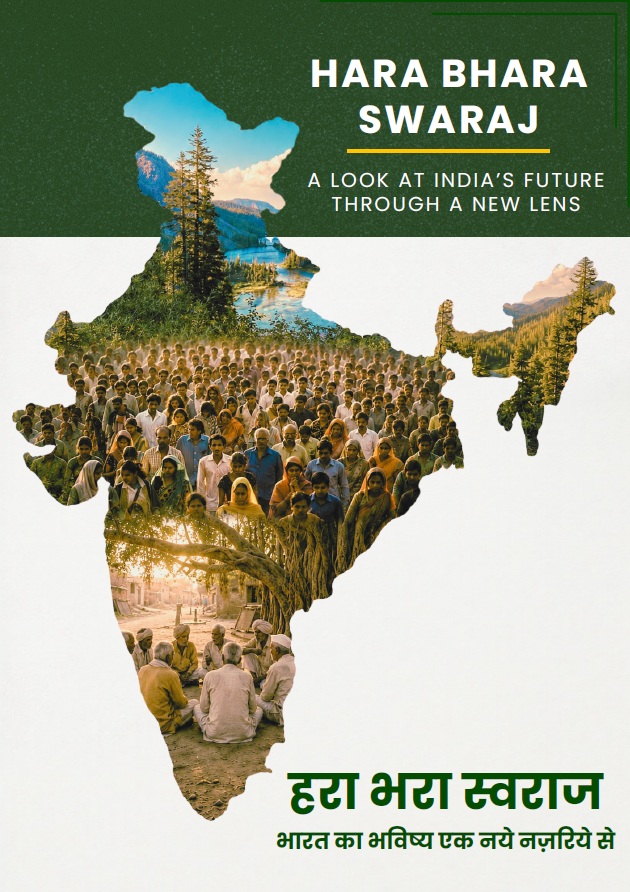
The report advances Hara Bhara Swaraj as freedom from contemporary ecological, social and economic deprivation. Part of the Rajiv Gandhi Institute for Contemporary Studies’ NEW LENS series, it offers a discussion framework rather than a fixed blueprint. Its estimates compile existing evidence, its case studies are illustrative, and its proposals require scrutiny and detailed programme design.
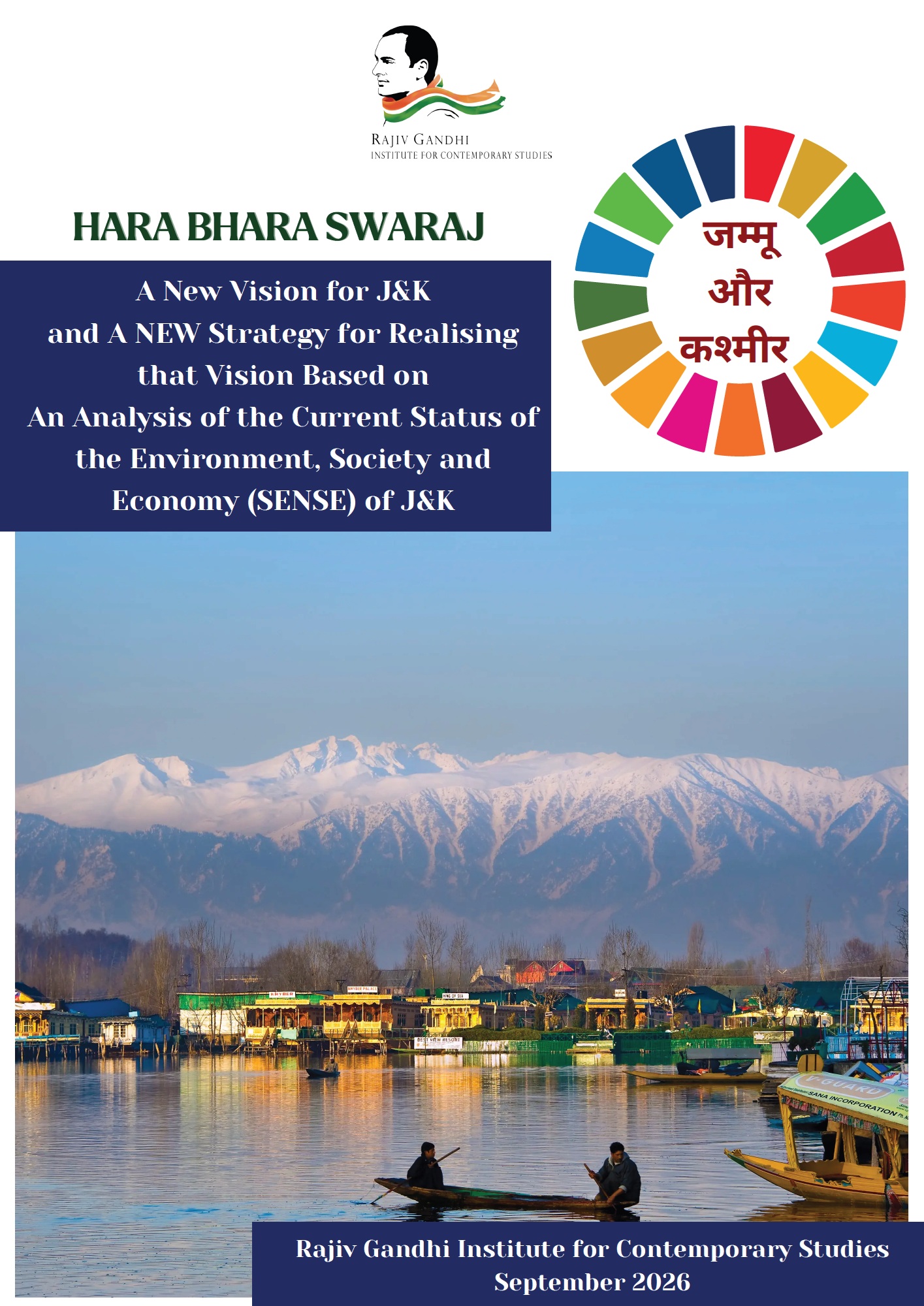
A New Vision for J&K and A NEW Strategy for Realising that Vision Based on An Analysis of the Current Status of the Environment, Society and Economy (SENSE) of J&K
Send download link to: