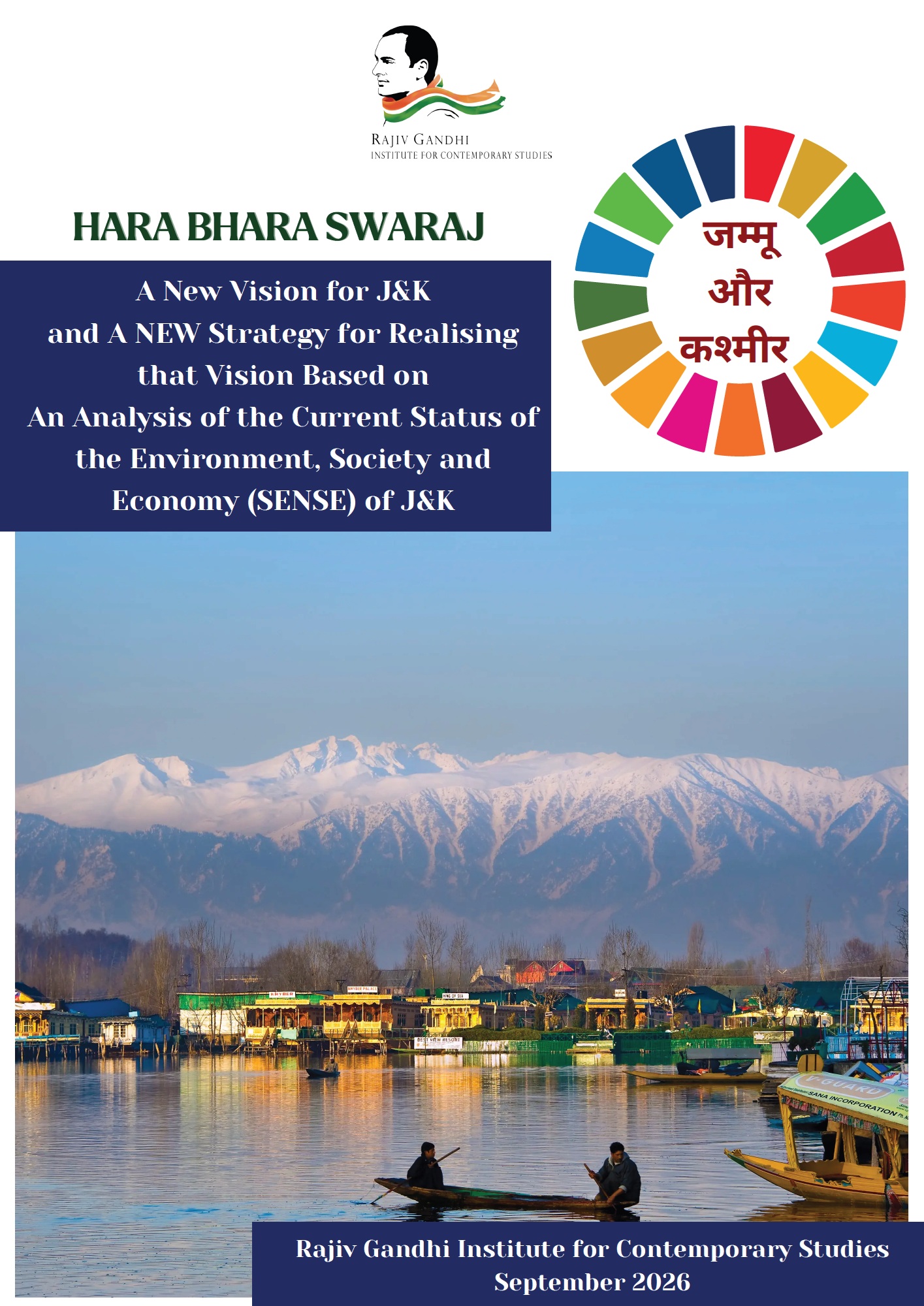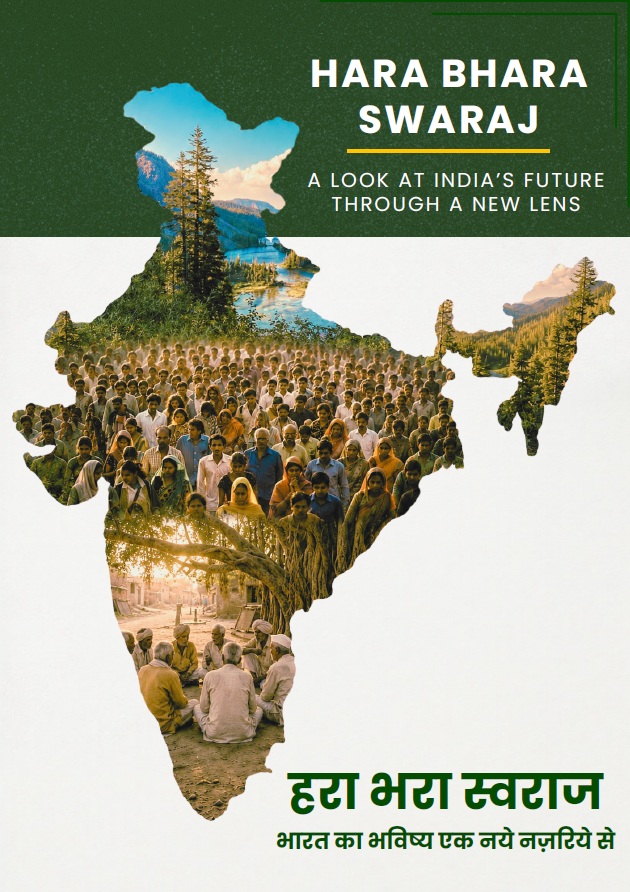

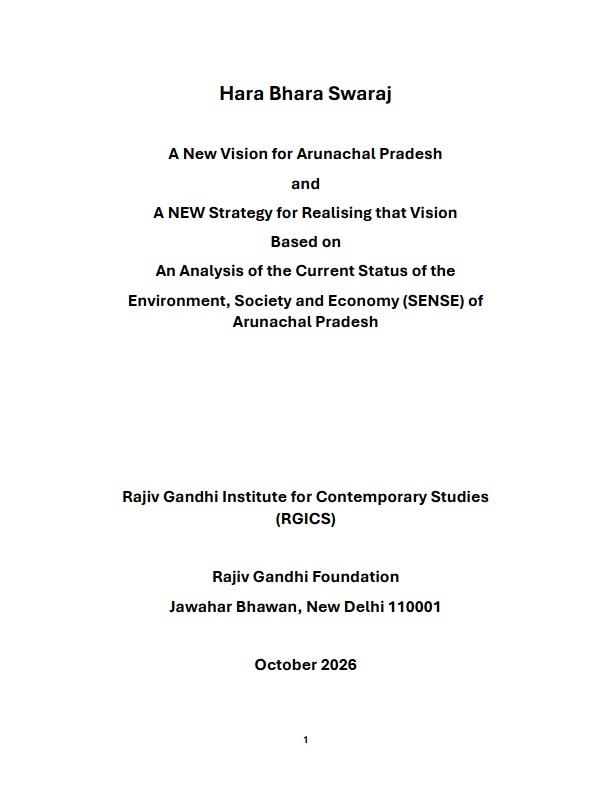
Hara Bhara Swaraj: A New Vision for Arunachal Pradesh proposes a development pathway that places ecological regeneration, community well-being and sustainable livelihoods at the centre of the state’s future. Prepared by the Rajiv Gandhi Institute for Contemporary Studies, the report examines the interconnected challenges facing Arunachal Pradesh’s environment, society and economy through the SENSE framework. Its central proposition is that lasting prosperity must emerge from restoring natural systems, strengthening people and institutions, and supporting responsible entrepreneurship—not from economic expansion that undermines ecological security or indigenous autonomy. The study combines government statistics, academic literature and policy documents with field observations and stakeholder consultations conducted between April and December 2025.
The interconnected development crisis
Arunachal Pradesh possesses extensive forests, major river systems, diverse agroclimatic conditions and rich indigenous ecological knowledge. These assets support livelihoods, cultural identity and community safety nets. However, steep terrain, fragile geology, dispersed settlements and vulnerable transport networks make both infrastructure development and public-service delivery difficult. The report identifies a triple crisis: ecological degradation, uneven human and institutional development, and limited opportunities for secure, productive employment. These challenges reinforce one another and require an integrated response rather than isolated sectoral programmes.
Environmental pressures include forest degradation, drying springs, soil erosion, river pollution, glacier retreat and increasingly unpredictable rainfall. Roads, hydropower projects, mining, settlement expansion and commercial agriculture can intensify these pressures when planning overlooks ecological limits and community rights. Social challenges include inadequate rural healthcare, weak foundational learning, gender inequality, substance abuse and the exclusion of remote populations. Economic constraints include weak market connections, costly logistics, insufficient processing and storage infrastructure, restricted credit access and a strong preference for increasingly scarce government employment.
The report also highlights changes in community ownership, collective resource access and traditional social protection. Indigenous relationships with land, forests and rivers are not merely economic: they underpin identity, knowledge and social organisation. Development that weakens these relationships risks increasing insecurity and inequality. Accordingly, the report advocates locally grounded planning that protects customary rights, strengthens collective stewardship and expands opportunities without treating Arunachal Pradesh simply as a frontier for resource extraction.
The NEW development strategy
The proposed NEW strategy integrates three mutually reinforcing pillars: Nature regeneration; Enabling human, social and institutional development; and Well-th creation through entrepreneurship. Its guiding sequence is to restore ecological foundations, build human capabilities and accountable institutions, and generate resilient livelihoods. The strategy draws on community cooperation and indigenous knowledge while introducing appropriate scientific, technical and financial support. It also aligns ecological restoration with the state’s climate-resilience ambitions under the Pakke Declaration 2047.
Nature regeneration focuses on Jal, Jangal, Jameen and Jalvayu: water, forests, land and climate. Priorities include river-basin treatment, springshed development, groundwater recharge, rainwater harvesting and restoration of damaged water bodies. Forest interventions combine assisted natural regeneration with mixed-species planting and agroforestry on degraded lands. Soil restoration involves erosion control, organic inputs, nutrient management and locally appropriate farming practices. Together, these measures seek to improve dry-season water availability, stabilise slopes, conserve biodiversity, strengthen agricultural productivity and reduce disaster-related losses.
Community participation is fundamental to this programme. Village micro-plans and wider catchment plans should incorporate customary tenure, indigenous ecological practices and women’s participation. Large infrastructure projects require meaningful environmental and social assessment, climate-risk screening and Free, Prior and Informed Consent. Monitoring should assess ecological outcomes through field verification, community records and geotagged observations, rather than relying solely on expenditure or construction targets.
Capabilities, inclusion and livelihoods
The enabling pillar addresses the practical barriers created by distance, dispersed populations and uneven institutional capacity. Healthcare priorities include mobile outreach, stronger primary care, nutrition support, preventive screening, referral systems and teleconsultation. Household improvements in water, sanitation and ventilation complement these services. Education follows the REPAIR, PREPARE and COMPERE approach: remedy foundational learning deficits, prepare young people through work-linked skills and apprenticeships, and recognise community-based craft and ecological knowledge. Functional school facilities and regular assessment are essential to translating enrolment into learning.
Institutional reform brings customary councils, panchayats, urban local bodies, self-help groups and youth organisations into more inclusive planning and oversight. Proposed mechanisms include monthly inclusion days, mobile government-service camps, public beneficiary lists, participatory budgeting, social audits and time-bound grievance resolution. Particular attention goes to women, adolescents, smaller tribal communities, migrants, persons with disabilities and underserved households. Local-language communication and assisted digital access are intended to prevent administrative and technological systems from creating additional exclusion.
Well-th creation centres on upgrading farms and non-farm enterprises through the DECI framework: Demand, Entrepreneurship, Capital, and Inputs or Infrastructure. Opportunities include horticulture, spices, livestock, mushrooms, beekeeping, bamboo products, non-timber forest produce and food processing. Tourism, transport, repair services, renewable-energy maintenance and care services can diversify employment. Farmer organisations and cooperatives can aggregate production, improve credit access and support storage, processing and marketing. Selected enterprises can serve metropolitan and export markets, while local demand remains a foundation for smaller businesses.
Investment and collective action
The report proposes approximately ₹74,070 crore over five years at 2026 prices: ₹56,310 crore for nature regeneration, ₹3,745 crore for enabling development and approximately ₹14,014 crore for enterprise development. It projects additional annual GSDP of ₹18,568 crore, approximately 3.54 lakh ongoing person-years of employment and ₹12,909 crore in annual wage income after maturation. These are planning projections, not realised outcomes. Proposed financing combines government budgets with private contributions, institutional credit, philanthropy, community participation and climate finance. Implementation requires coordinated action by citizens, civil society, local institutions, governments and international partners, with transparent monitoring and protection of community rights throughout.
A New Vision for Arunachal Pradesh and A NEW Strategy for Realising that Vision Based on An Analysis of the Current Status of the Environment, Society and Economy (SENSE) of Arunachal Pradesh
Send download link to: