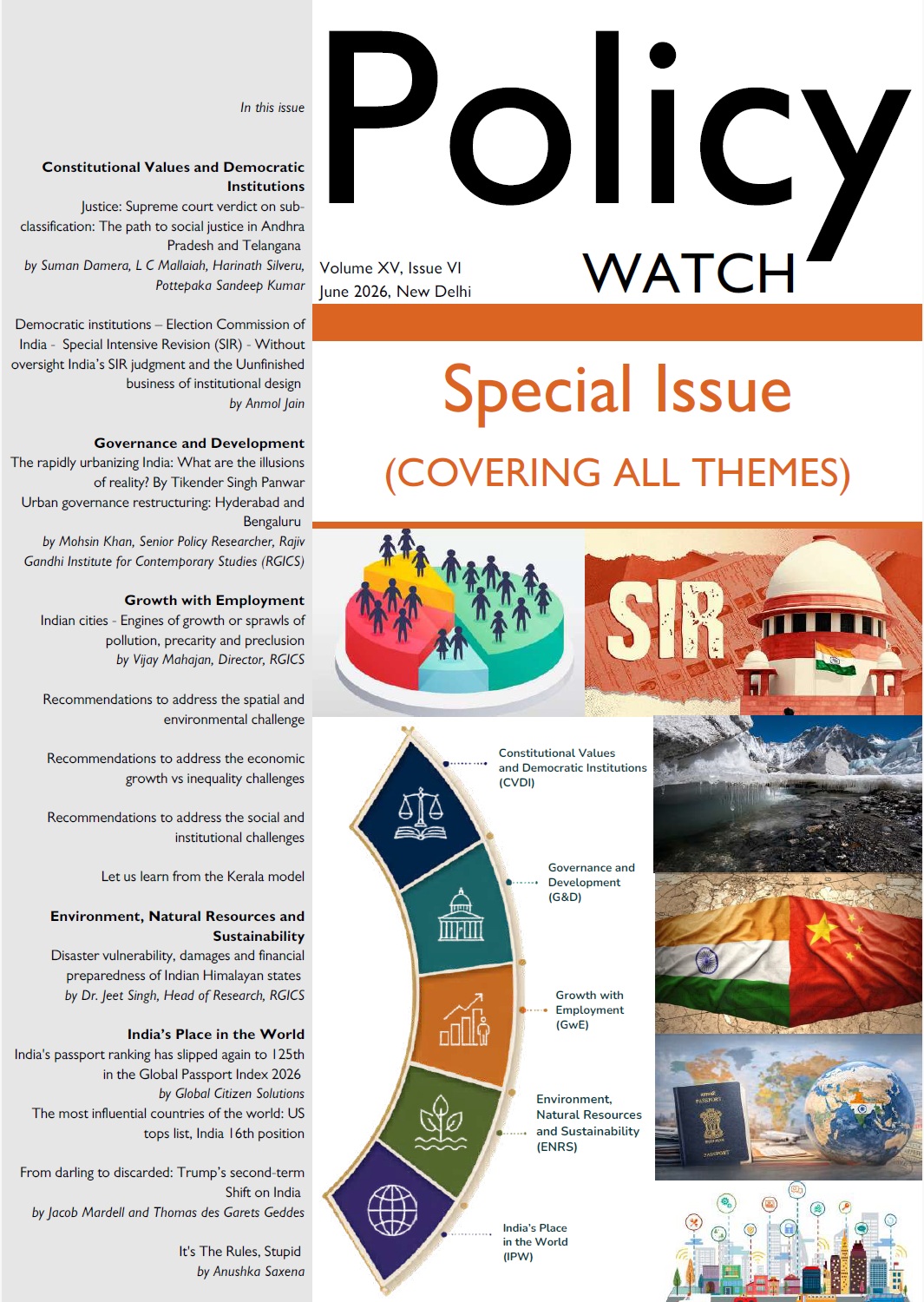

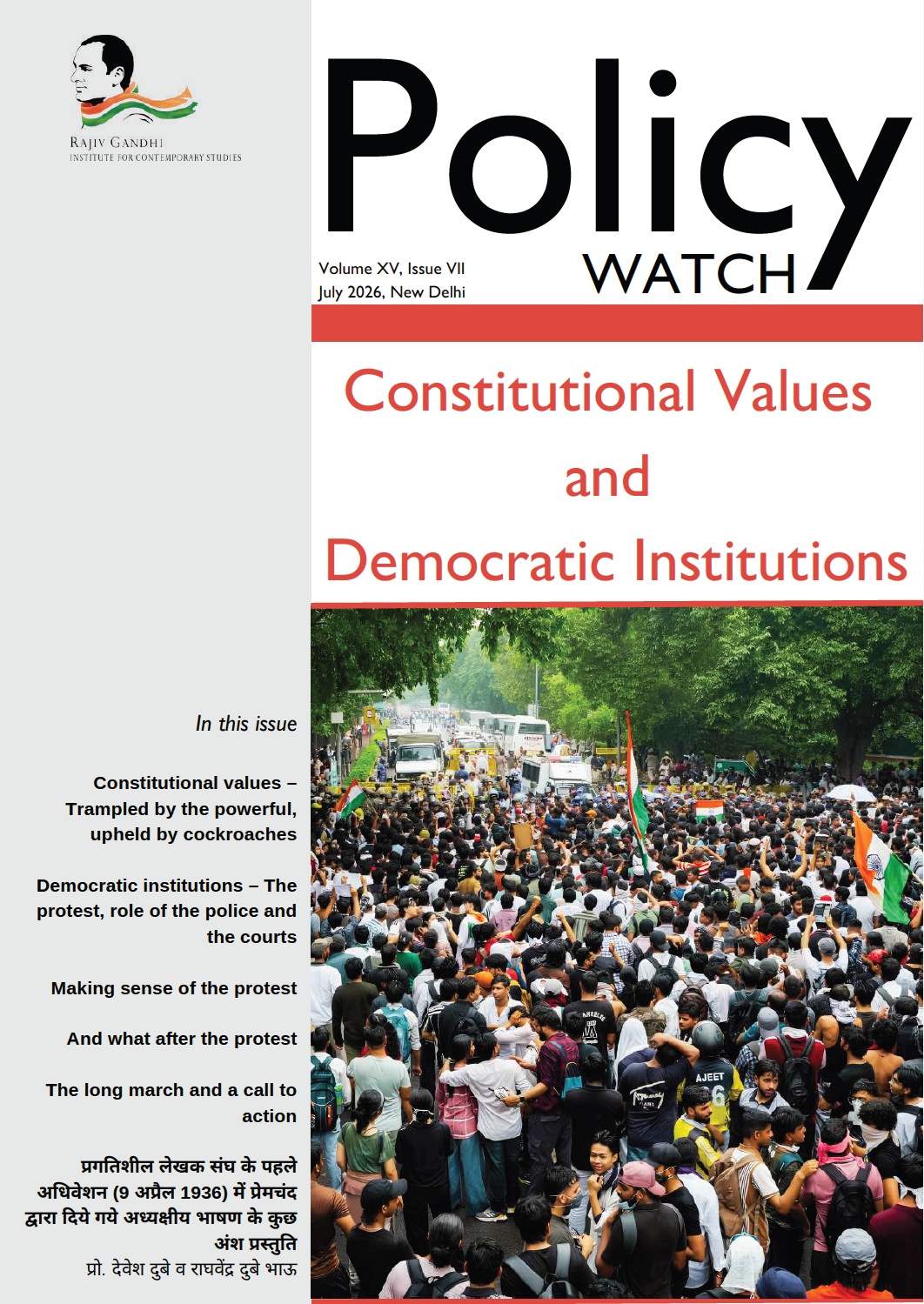
This issue is on the theme Constitutional Values and Democratic Institutions. In view of the momentous happening in India in the month of July 2026, we have selected most articles pertaining to the youth protest in Jantar Mantar, Delhi and in numerous places in the rest of the country. The issue is divided into five parts, with two or more articles in each part. The five parts are: Constitutional Values, Democratic Institutions, Making Sense of the Protest, And What After the Protest, The Long March and Call to Action.
We begin with one article each on how the values enshrined in the preamble of the Indian Constitution—Justice, Liberty, Equality and Fraternity—were upheld or denigrated during the protest. Then we carry several articles on how four of our Democratic Institutions—the People (as Protesters), the Parliamentary Opposition, the Police and the Courts—have behaved during this epochal agitation.
We then move to three articles which are written in the aftermath of the protest, to try and make sense of it. Pratap Bhanu Mehta strikes a hopeful note, pointing that “The government will now never recover its untrammelled authority; there will be internal confusion even among BJP supporters. The Opposition has hopefully realised that corroding the authority of the government with a broad front is far more important than their own petty differences. It will be interesting to see if coalition partners now hesitate more in supporting BJP’s far-reaching legislative agenda. But it is not going to be easy to stem the rot in Indian higher education.”
Suhas Palshikar strikes a pessimistic note, in an article titled Protests are over. Determination not to learn anything from them remains. He concludes: “In sum, the prelude, the actual protests and now their aftermath tell a common story — protests have stirred many minds but not our political leadership. Because the regime is bent on not learning anything from the protests except the technology to suppress the next round of protests.”
Ashish Malhotra takes the point forward in the next article: “In a country with high levels of inequality and poverty, education is seen as many people’s best shot at social mobility. Poor families spend life savings and take out ruinous loans to pay for years’ worth of test preparation for their children, in hope that passing exams like the medical entrance one will give them a better life. For the kids, studying can dominate entire childhoods.” However, he ends pessimistically, quoting Mumbai-based journalist Rana Ayyub: “There’s nothing really that’s going to change,” Ayyub said. “The country lost the momentum when it was really going in a direction where we could have sought some accountability.”
Next is a classic BBC-style article by Soutik Biswas, based on interviews with several experts. Apart from Palshikar, cited above, there are insights from Yamini Aiyar, former Director of the now muzzled Centre for Policy Research, one of India’s top think tanks. She said: “The exam and education system cuts across caste, class and gender to quite a large degree. There is deep economic dissatisfaction and distress, which has translated into a lack of hope about the future… People are seeking accountability for governance in sites that are non-electoral. The split between electoral legitimacy and democratic accountability outside electoral space is the new phenomenon of politics in India.” Soutik Biswas then quotes economist Surajit Mazumdar of Delhi’s Jawaharlal Nehru University, who also believes the movement already points to something much larger than examination paper leaks.
The next section is on What After the Protests? Here too, we carry three articles. The first is a thoughtful piece by Saurabh Raj, who sees the protest as a step towards the making of the “critical citizen.” He describes Gen Z as a generation that participates but does not trust the system. He asserts that social movements create “critical” citizens before they work for reforms, and it is for the charismatic leaders of the movement to navigate this process in the right direction. That is the democratic challenge ahead.
India’s techno-doyen Sam Pitroda, as always, looks at the future in a constructive manner. Taking a leaf from the Arab Spring, Pitroda says: “This Monsoon moment calls for a new national agenda. The government must restore complete confidence in our education and examination systems. It must create millions of meaningful jobs by encouraging decentralisation, district-level development, entrepreneurship, innovation, and local manufacturing. India possesses the raw young talent, entrepreneurial spirit, and digital foundation to become a global leader in AI for public good.”
In the next article, Raghuram Rajan advises the Opposition to seize the moment and offer concrete alternatives to the problems of the economy and of exclusion. “An Opposition cannot only oppose, it needs to propose. It needs a plan to better the government’s plan. The plan must sway minds but also touch hearts.” The economic part of his advice is more likely to be heard, where he says: “The Opposition has to rethink its approach to education, skilling, and public healthcare, including how additional resources are spent. Unless we improve nutrition and the quality of pre-school and primary education for all, too many young people will struggle to learn — how can we become developed? That means hard choices, for example, fewer subsidies to chip foundries and more to tackle malnutrition.”
We end with an article by the undersigned to counterbalance the point made in several of the cited articles that the protest, while it shook the government, may not bring about much change other than in the examination system. The government’s prompt action in enacting a law against examination leakage malpractices and establishing a high-profile task force to revamp the examination system seems to indicate that this indeed may be acted on. Nevertheless, this is just the first step in the long march to what the youth really want: affordable and good quality education, decent employment, and empowerment as citizens. In this article we explore what is involved in that long march.
While the three demands were conceded within a few weeks of the CJP mobilization, there is a long march from examination reform to ensuring wider access to quality education, to establishing reliable linkages between education and employment, and ensuring that education is not only for “naukri” but indeed for empowerment. While the youth have led by example, the rest of us must be exemplary in supporting the long march to Hara Bhara Swaraj.
To help us along, today 31st July 2026, on his 146th birth anniversary, let us read what Munshi Premchand spoke in the Presidential speech of the Progressive Writers’ Association in 1936. We carry excerpts, in the original Hindi, of his call to action, which is still valid today in spirit.
Policy Watch: Constitutional Values and Democratic Institutions - July 2026
Send download link to: