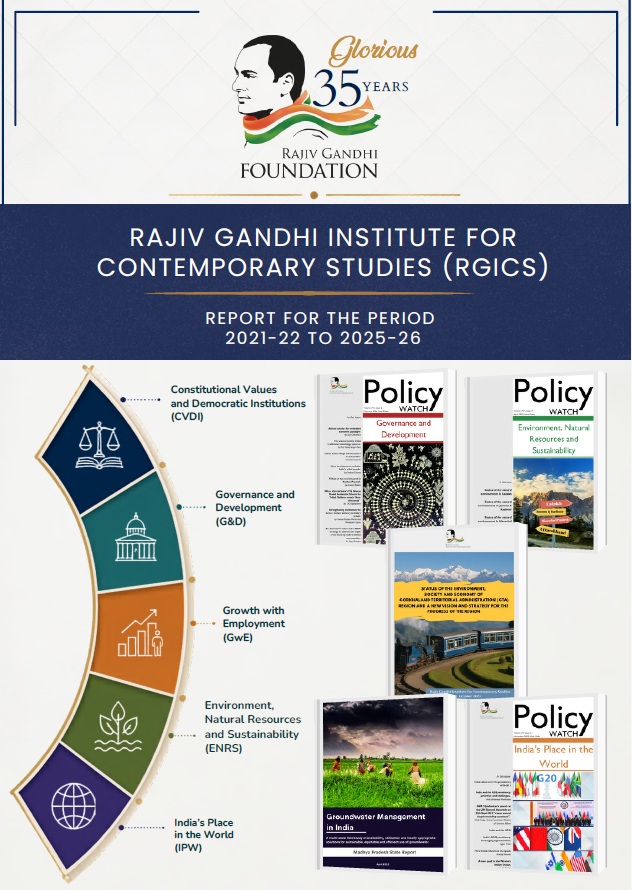

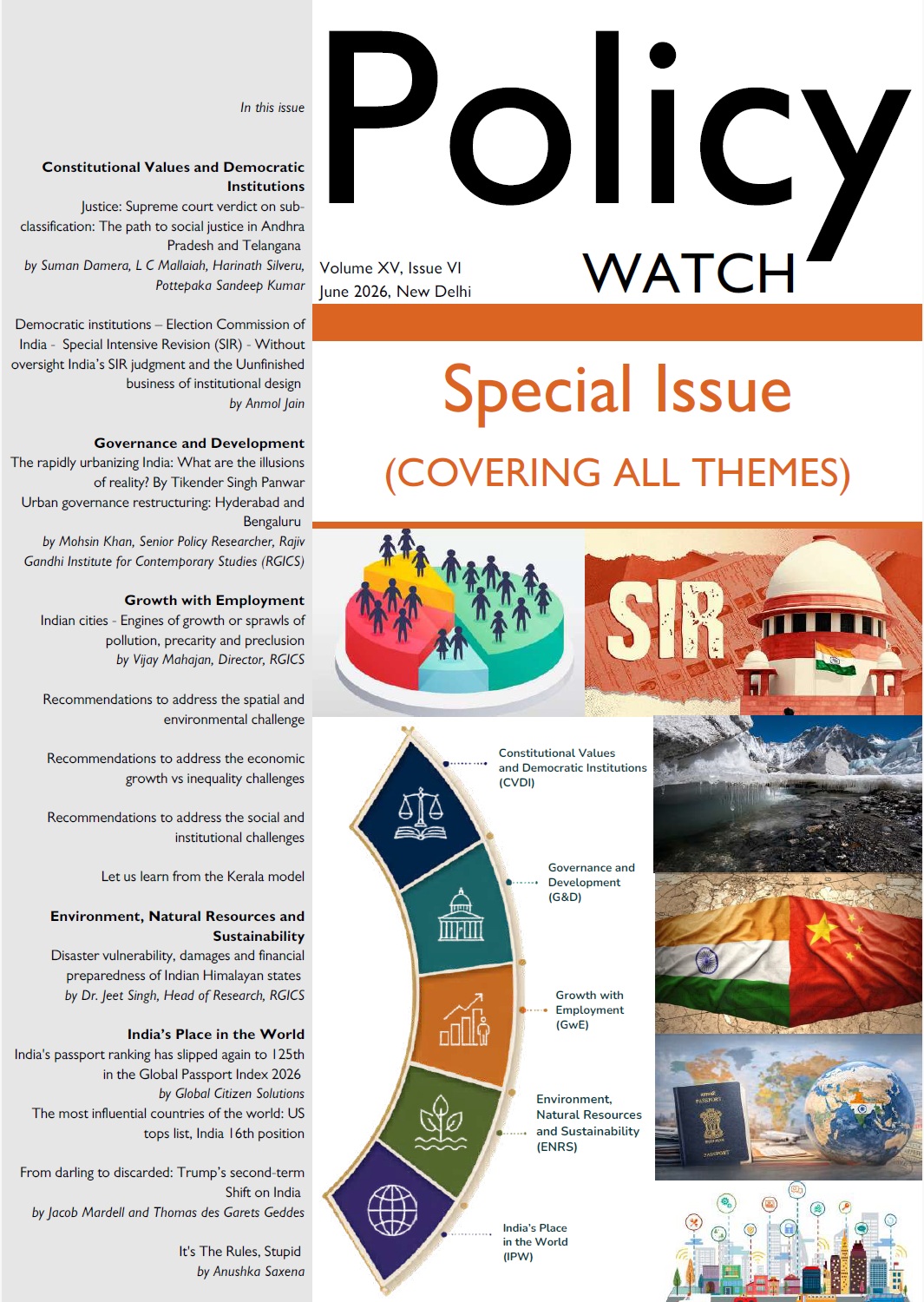
The Rajiv Gandhi Institute for Contemporary Studies (RGICS) works on five themes:
- Constitutional Values and Democratic Institutions
- Governance and Development
- Growth with Employment
- Environment, Natural Resources and Sustainability
- India’s Place in the World.
We bring out the monthly Policy Watch on each of these themes sequentially and every sixth issue is a Special Issue, where we carry articles from each theme. This is a special issue in which we carry one article on each theme.
The first set of two articles of this issue is on the theme Constitutional Values and Democratic Institutions. Of the four Preamble values of Justice, Liberty, Equality and Fraternity, we have included just one article on Justice which we consider the bedrock of other values. On Democratic Institutions, we have covered the Election Commission of India, and its conduct of the Special Intensive revision (SIR) of electoral rolls.
The second theme is Governance and Development. As the RGICS is engaged in a study of urban communities in India, we offer two articles from our team members. The first one by Tikender Singh Pawar, former directly elected deputy mayor of Shimla from 2012-2017, critiques the NIUA’s definition of urbanisation based largely on spatial-physical infrastructure considerations, and not at all on democratically elected, accountable local self-governments of urban municipalities. The second article by Mohsin Khan, a TISS Mumbai senior policy researcher who has been with the RGICS for several years, deals with the “democratic governance deficit” in two of our fastest growing cities – Bengaluru and Hyderabad. Khan shows that in the 32 years since the 74th Amendment took effect in these cities, they have had elected municipal government in place for only about 50-60% of the years, with all its adverse consequences. This article has been written in preparation for a much more detailed study of how the governance of a city affects the quality of life of its inhabitants and its economic growth.
The third theme Growth with Employment, continues to focus on urban India, since it has been declared as the growth engine. There we carry an article by Vijay Mahajan, Director, RGICS, which summarises the early recommendations of the study urban communities, which has so far covered 25 of the 50 cities it is planned to cover, taking a comprehensive view of the spatial-environmental challenges, the economic growth and inequality challenges and the social-institutional challenges.
The study suggest that while cities may be the engines of growth for the economy and provide employment to millions of people coming from rural areas, the stark reality for most of the inhabitants is survival wages and a poor quality of life. This has been summarised in the title of the half-way draft report – Indian Cities – Engines of Growth or Sprawls of Pollution, Precarity, and Preclusion.
The fourth theme, Environment, Natural Resources and Sustainability, carries an article by Dr Jeet Singh, Head of Research of the RGICS on the issue of Disaster Vulnerability, Damages, and Financial Preparedness of Indian Himalayan States. This matter has become of urgent importance not only because the frequency and magnitude of disaster in the Himalayan region are going up, but they are reaching proportions where downstream states in the foothills and the plains are getting affected. The recent example of floods in Punjab are just a precursor to what Uttar Pradesh might see if the glacial melting, forest denudation and landslides due to road building are not curbed. Dr Jeet Singh shows that while the Himalayan states bear the brunt (% ) of the disaster damage, they get a much lower share of financial support to deal with the damage after the event, leave alone work to mitigate these in the future.
The last theme is India’s Place in the World. Here, in keeping with the divided opinion on the matter, we present two recent international rankings in which India appears at vastly different levels. In the International Ranking of Passports, which is based on an analysis of fourteen indicators across three weighted pillars: Enhanced Mobility, Investment, and Quality of Living. In contrast, India appeared at the 125th position On the other ranking of the top influential countries in the world, India is at the 16th position. This is based not so much on a country’s basic financial numbers but on how well the society functions by looking at things like public participation, environmental laws, medical care systems and transport networks. By using this method, each country is judged on how it performs across eight specific areas of national well-being. We end by an article including the views of Mao Keji, an up-and-coming India specialist at China’s influential National Development and Reform Commission (NDRC). The title “From Darling to Discarded: Trump’s Second-Term Shift on India” says it all. This is followed by a tailpiece from the recent issue of Eye on China with a few telling expert comments in the boxes. It says a lot about how the Chinese see India’s Place in the World.
Policy Watch: Special Issue - June 2026
Send download link to: