
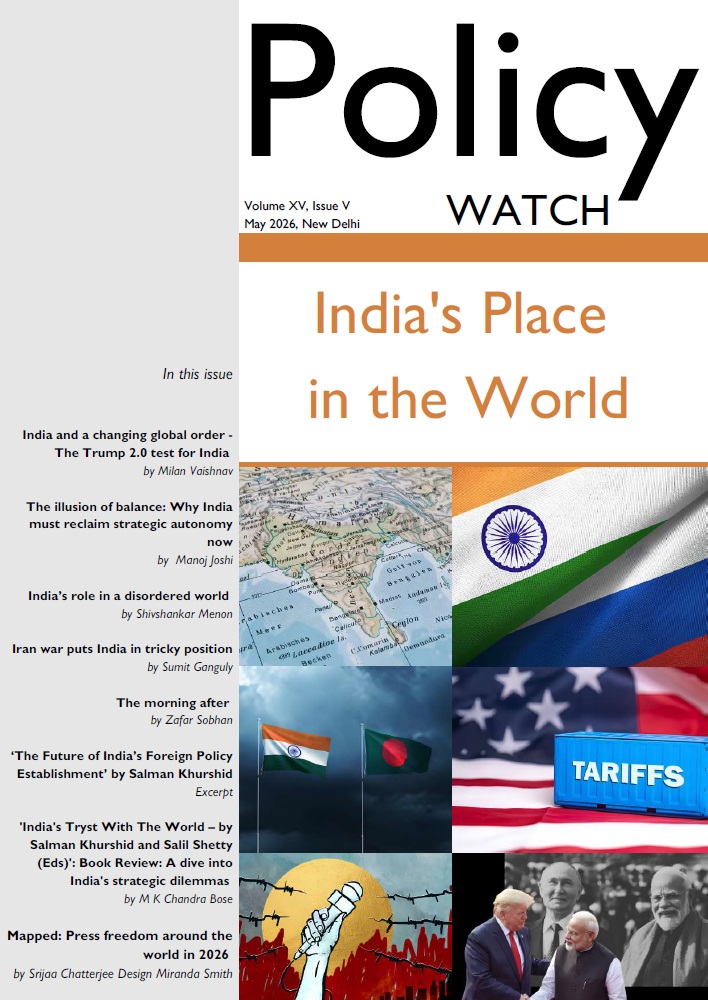
This issue of Policy Watch begins with an article on President Trump’s second term in office for a year and its impact on the globe. The second Trump administration has adopted a more assertive and unpredictable approach to U.S. foreign policy—deploying tariffs and other economic tools against both rivals and partners, expressing open hostility toward multilateral institutions, and pursuing a highly transactional, personalized style of diplomacy. These developments have unfolded amid intensifying geopolitical competition and the weakening of the post-Cold War international order, contributing to a more fluid and uncertain global landscape.
The second article examines India’s relationship with various major powers. India’s foreign policy has been using the phrase strategic autonomy. The current moment demands that it be exercised, not merely declared. The conditions that have opened this window – a US distracted by West Asia, its sanctions architecture under strain, Indian leverage quietly elevated – will not persist indefinitely. What we have may not quite amount to a geopolitical windfall, but it is certainly a major opportunity to work up the nerve to state our interests plainly. Strategic autonomy cannot rest on borrowed luck or tactical manoeuvre. It must rest on accelerating defence manufacturing. building strategic petroleum reserves beyond the current 5.3 million MT and completing the INSTC infrastructure that links India to Russia and Central Asia through Iran – refusing to abandon Chabahar as an American concession.
In the third article, veteran Shivshankar Menon examines the changes in the international system which make it much harder for Indian foreign and security policy to enable the transformation of India into a modern, prosperous, and secure country. A disordered world is not likely to give India the peace, predictability, and security that India’s development needs. Yet these challenging circumstances also represent a chance to change what we do. Rather than getting involved in others’ quarrels or engage in mediation, the greatest contribution that India can make at this time is to continue to manage its own development and security well.
By working with its partners and neighbours, it should aim to provide stability in the subcontinent, the Indian Ocean littoral, and southeast and west Asia. In addition, where circumstances permit, India should work to strengthen predictability and stability on international issues critical to India and others’ future.
The fourth article deals with the impact of the Iran war on U.S.-India relations, which entered troubled waters after Trump imposed harsh tariffs last year, may now face more turbulence. Key members of India’s attentive public are now explicitly warning Modi that his government’s unwillingness to express its reservations about the war against Iran could jeopardize India’s enduring national interests. It is obviously in the interest of the Modi government to adopt a nonconfrontational approach toward the United States—it can’t afford to alienate the Trump administration. Far too much is at stake, from trade and investment to defence ties. The Modi government faces increasingly vocal domestic dissent when it comes to working with the Trump administration. In the past, it could fend off these criticisms and pursue policies that it deemed to be beneficial. However, criticism is growing louder—and it is not confined to the opposition benches.
The next article is by a Bangladeshi journalist. He states that “For decades the BJP’s entire electoral strategy in West Bengal has been based on anti-Bangladesh rhetoric, and while their recent victory. [is] a calamity for India’s religious, linguistic, and ethnic minorities. But the question for us here in Bangladesh is what does it mean on this side of the border and what are the implications for relations between our two countries. The short and dispiriting answer is: nothing good.”
The next two articles are related to the recently released book, ‘India’s Tryst With The World: A Foreign Policy Manifesto”, co-edited by Salman Khurshid, former Minister of External Affairs in the UPA government and Salil Shetty, formerly global CEO of Amnesty International and the UN Coordinator for the Millennium Development Goals (MDG) before that. We carry an excerpt from the article in the book by Salman Khurshid and then a review of the book by M K Chandra Bose.
Finally, we carry an article mapping the global state of press freedom. It has reached a 25-year low, according to the latest World Press Freedom Index from Reporters Without Borders (RSF). The index ranks 180 countries and territories based on five indicators: political context, legal framework, economic context, sociocultural context, and journalist safety. India was ranked 157, a few ranks below Pakistan and Bangladesh.
The issue was largely put together by Prof Somnath Ghosh, Senior Visiting Fellow, and Vijay Mahajan, Director, RGICS. The issue was delayed because we kept waiting for the Iran war to end, or at least have a stable truce, so that we could carry some articles analyzing that good news. Unfortunately, the wait turned out to be futile, despite several false starts,
This issue of Policy Watch is aimed not at the expert-scholar but those who would like to have a deeper than a layman’s understanding of the recent developments in India’s foreign relations and the underlying dynamics behind these. We hope it serves that purpose.
Policy Watch: India's Place in the World - May 2026
Send download link to: