
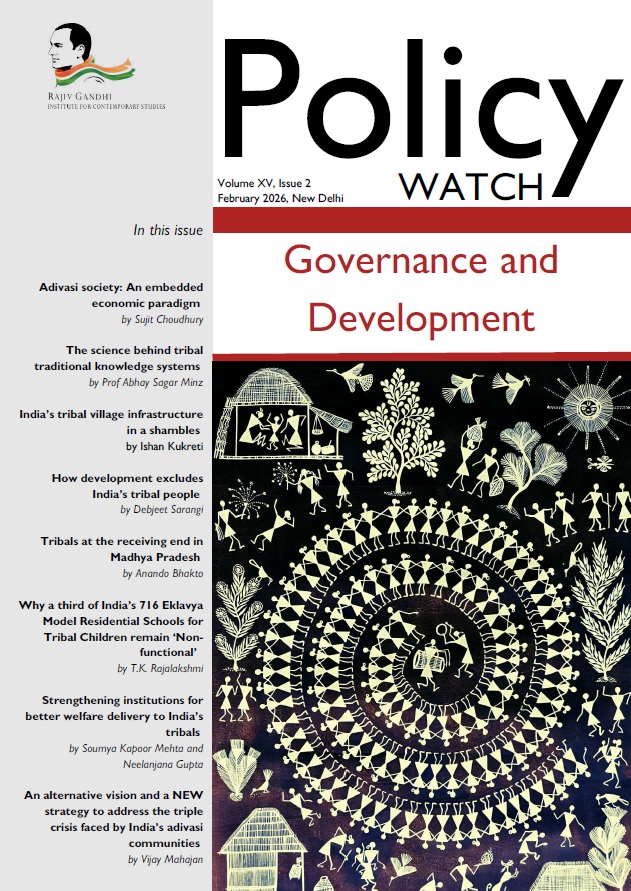
Policy Watch: Governance and Development — Tribal Communities at the Centre
This issue of Policy Watch, published by the Rajiv Gandhi Institute for Contemporary Studies (RGICS) under the theme Governance and Development, brings together critical reflections on the persistent challenges faced by India’s tribal communities. The issue has been curated by Prof. Somnath Ghosh, Senior Visiting Fellow, RGICS, along with the editorial team, drawing insights from field visits to Pakur (Jharkhand) and Nandurbar (Maharashtra)—districts marked by high tribal populations and severe multidimensional poverty.
The publication emerges from RGICS’s ongoing multi-state study examining the Status of Environment, Society, and Economy of Tribal Communities across eight tribal-dominant states. The collected articles—most republished from other sources due to their contemporary relevance—collectively highlight how governance gaps and exclusionary development models continue to shape tribal deprivation, with little material improvement for Particularly Vulnerable Tribal Groups (PVTGs).
The issue identifies key problems: erosion of traditional knowledge systems, inadequate infrastructure in tribal regions, weak implementation of welfare laws such as the Forest Rights Act (FRA) and Panchayats (Extension to Scheduled Areas) Act (PESA), institutional inefficiencies in programme delivery, and rising social vulnerabilities. Evidence cited includes underutilised Tribal Sub-Plan funds, rejection of forest rights claims, non-functional residential schools, and increasing crimes against tribal communities, underscoring systemic governance failures.
At the same time, the articles propose important solutions. Indigenous economic systems rooted in harmony with nature are presented as viable alternatives to extractive development paradigms. Strengthening local governance, empowering Gram Sabhas, improving institutional accountability, and integrating traditional knowledge into policy design emerge as critical pathways.
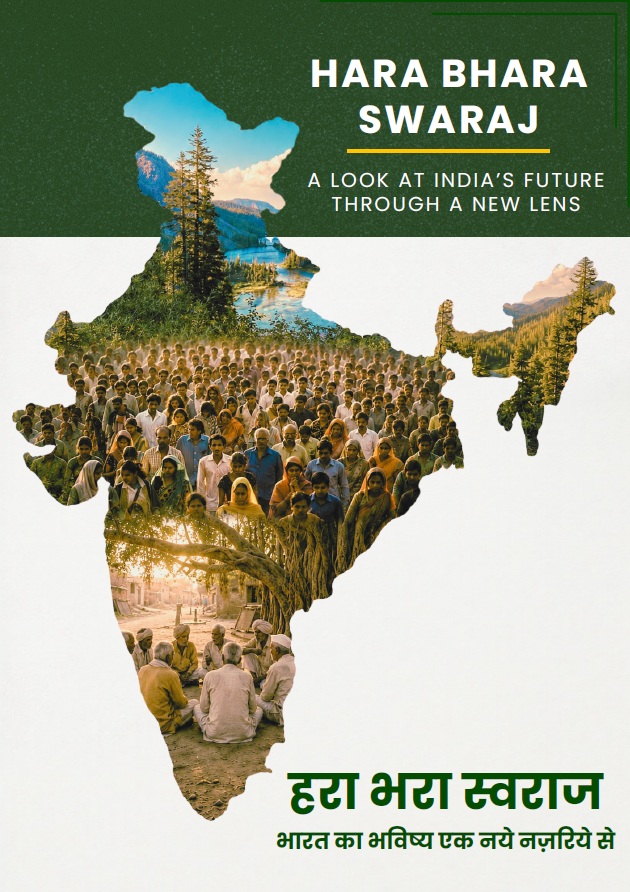
The issue concludes with a forward-looking framework—Hara Bhara Swaraj—advocating a development strategy centred on Nature regeneration, Enabling social and institutional development, and Well-th creation through community enterprises. Together, the contributions call for participatory governance and policy reforms that align development with ecological sustainability and tribal self-determination.
Keywords: Governance and Development, Tribal Communities India, Adivasi Development, Inclusive Governance, Tribal Policy India, Particularly Vulnerable Tribal Groups (PVTGs), Forest Right Act (FRA), Multidimensional Poverty Index, Community Led Development, Hara Bhara Swaraj.
Policy Watch: Governance and Development - February 2026
Send download link to: