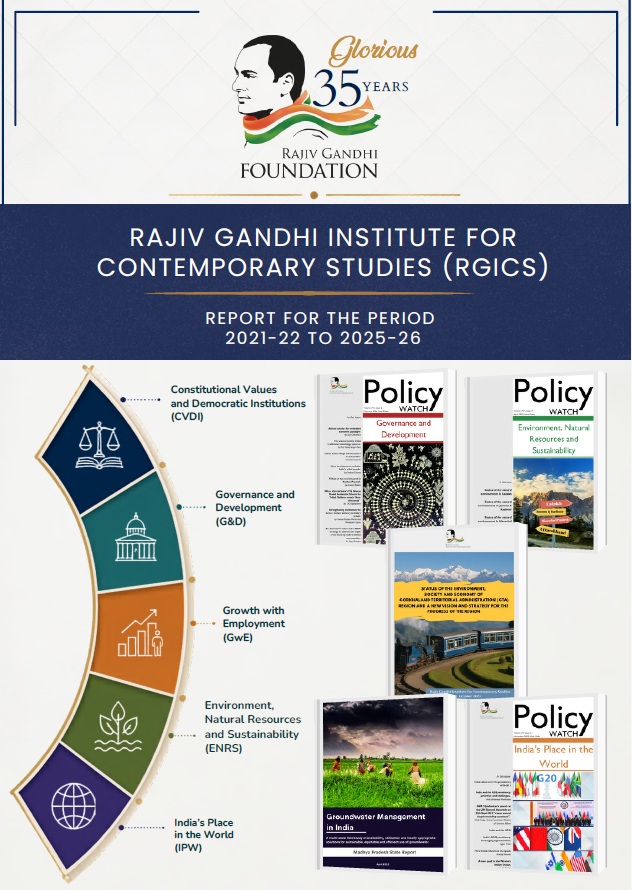
The Rajiv Gandhi Institute for Contemporary Studies (RGICS) works on five themes:
Constitutional Values and Democratic Institutions
Growth with Employment
Governance and Development
Environment, Natural Resources and Sustainability
India’s Place in the World.
This issue of Policy Watch is on the theme Constitutional Values and Democratic Institutions and has been put together by RGICS Senior Visiting Fellow, Prof Somnath Ghosh and the undersigned. The issue focusses on how the three pillars of the Constitution – the legislature, the executive, and the judiciary – have discharged their obligation to the first tenet, Justice, as mentioned in the Preamble to the Constitution. Given the ambit of our journal, we will focus on contemporary developments.
We begin with two overview articles on the idea and the state of our constitutional values and democratic institutions. Yogendra Yadav draws our attention to the distinction between “Ganarajya or ganatantra? Our passport and the Indian Constitution name our republic as ganarajya. But our Republic Day is officially called Ganatantra Divas. A small discrepancy, you might think. Perhaps an oversight. Or, maybe a nuance.” The descent for the idealism of the Preamble on 26th Nov 1949 to the pragmatism of the parade on 26th January 1950, seems rather abrupt, at least in retrospect. But whether it was preordained or premeditated, the task at hand is to restore the idealism, its Svadharm, and that is what Yogendra Yadav argues for in the article.
In the next article we go from the profound to the profane – the reality of the multiple mutilations that our Constitutional Values and Democratic Institutions (CVDI) are suffering – documented in detail by Pushpraj Deshpande and Parsa Mufti. They give a grand overview of how the three organs – the Judiciary, the Legislature and the Executive – have all not just failed to protect the CVDI but also are destroying them.
In the next three sections are respectively about the Judiciary, the Legislature and the Executive. We hold that the judgements must pass the test of common people’s sense of justice rather merely meeting the test of legality. A sense of justice is an innate moral compass and subjective perception of fairness, right, and wrong, guiding individuals to believe everyone deserves equitable treatment and that harmful acts are wrong because they hurt people or society. It is the moral underpinning on which the values of liberty and equality rest, which are more vital for the unduly caged and the dispossessed. But denial of or delay in justice, based on power positions of the accused, deprives the powerless of liberty and violates the principle of equality before the law, enshrined in Article 14.
We begin with a look at how the judiciary, which is the guardian of the Constitution, has protected the fundamental rights of citizens to secure justice, the first tenet of the Constitution. In recent times, no judgement of the Supreme Court has been as controversial and drawn as much criticism as its judgement relating to denial of bail to Umar Khalid and Sharjeel Imam. In the article titled “Judging by Whim…”, Sourav Das says: “With one interpretive stroke, the Supreme Court has possibly given the State a terrifying gift: the ability to charge democratic dissent as terrorism and then use the bail bar to ensure that the punishment is the process… judgment is not constitutional adjudication.
It is adjudication by whim, like that of a khap panchayat, where the outcome is moralised, the rights are sermonised, precedents are pushed aside, and the citizen is reminded, once again, that the Constitution is not a shield, but a text the judge cites according to his inclination at the moment.”
The next section deals with the functioning of the legislature. In the first article, “The deliberate unmaking of India’s ‘right to work’”, Zoya Hasan, Professor Emerita, Centre for Political Studies at Jawaharlal Nehru University holds that the repeal of MGNREGA, and its substitution by the Viksit Bharat Guarantee for Rozgar and Ajeevika Mission (Gramin) (V-G RAM G) Act, 2025, marks the erosion of a foundational principle of India’s democracy and a political transformation of welfare.
We get somewhat similar flavour in DMK MP P Wilson’s measured speech in the Rajya Sabha on the Sustainable Harnessing and Advancement of Nuclear Energy for Transforming India (SHANTI) Bill (now an Act). He points out that according to the proposed Bill, one corporate entity could control mining, fuel fabrication, reactor operation, and radioactive waste handling, leading to a dangerous concentration of power. And such monopolisation exponentially heightens systemic risk. When one operator controls everything, a single failure – technical, financial, or ethical – can trigger catastrophic consequences. A private person could threaten the nation’s security and still get things done. Wilson made a fervent plea on 18th December 2025 to junk the Bill or at least send it to a Select Committee of Parliament, On the very next day, however, the President gave her assent after Parliament passed it. We also carry a small announcement poster by the Nuclear Business Platform as an answer to the question in the title of Wilson’s speech.
The next section deals with the Executive. The sense of justice is pivotal in the debate on the Special Intensive Revision (SIR). In the very first article in this section, “Bihar’s SIR pushes burden of proof onto the poor, against Supreme Court precedent”, Soni Mishra says that by sidelining the Lal Babu Hussein judgment which was delivered by a three-judge bench headed by the then Chief Justice of India A.M. Ahmadi acting upon a clutch of petitions filed in 1994 and 1995, the Election Commission has shifted the burden of proof of citizenship on to the voter.
The next article, “The ECI’s credibility collapse” by Parakala Prabhakar incisively exposes the EC’s failures on multiple counts: lack of internal consistency in phasing of election schedule; the inordinate delay in announcing the final numbers; unusually high discrepancy between the provisional polling figures at the closing time of voting and the final polling figures notified by the ECI after a delay of several days. There were also discrepancies between votes polled and votes counted in 538 out of 542 constituencies that voted.
The final section is on the Perils of Majoritarianism. In our special issue in June 2025, we had carried an article by Dr Ravinder Pal Singh titled “Should India Become a Majoritarian State or a Constitutional Democracy?” The articles in this section tell us what can happen if India moves further towards becoming a majoritarian state.
Ghazala Ahmad’s piece, “’Police watched silently”: Muslim homes, shops, mosque set ablaze by Hindutva group in Tripura’s Fatikroy”, depicts a familiar story playing out in different parts of the country.
Next, lest we forget, we carry an article by Suresh Khairnar, former head of the Rashtriya Seva Dal on the martyrdom of Graham Staines and his sons 27 years ago. The then President K.R. Narayanan had said: “Instead of expressing gratitude to Graham Staines, who served leprosy patients for years, the people of Odisha killed him, damaging India’s image of tolerance and humanity. This makes India ethically corrupt.” We agree with Khairnar’s exhortation – “All peaceloving people who believe in Sarva Dharma Sambhava must unite and actively confront these forces of hatred.”
But the adverse impact of majoritarianism is not only on minorities, it is also on Hindus. In the third article in the is section in Hindi, Swami Raghavendra Das lays out persuasively how the Hindu religion has been distorted to pursue political goals and as a result we have a situation जब संस्कृति का स्थान केवल उद्घोष ले, साधना का स्थान प्रदर्शन और विवेक का स्थान शोर ले, तब धर्म उपासना उत्सव नहीं रह जाता, वह तमाशा बन जाता है। यह युग विवेक–विमुख और देवी–विस्मृत प्रतीत होता है, जहाँ नाम तो बहुत हैं, पर अर्थ लुप्त हो गए हैं।
We repeat his fervent plea:
भारत आहत है, जिसके घाव बाह्य शत्रुओं से अधिक, आंतरिक विस्मृति और मिथ्या अभिमान के उद्घोषों से क्षय हो रहे। हे माँ वाग्देवी! हमारे देश को अभिशाप से मुक्त करो।
Policy Watch: Constitutional Values and Democratic Institutions - January 2026
Send download link to: